Life in a Maharashtrian Village: Zai’s Return to Decline
This photo essay explores the sea as a participatory body in the life of the fisherfolk residing in Zai which is a coastal village located in the Palghar district of Maharashtra. The exploration organically expands to observe how the community ties the intangible elements of their oral history to ‘maps and memories’ by studying their occupational culture, material culture and their social interaction with the environment. Mrunmayee has spent most of her childhood in Zai’s neighbouring village called Bordi, where she lived with her grandparents not more than a hundred metres from the sea. This had a huge impact on her as a child and shaped her decision to work with the fisherfolk of Zai for her undergraduate dissertation at Pandit Deendayal Petroleum University, Gandhinagar. This story is an outcome out of the said inquiry. The author would like to thank the people of Zai for their guidance, goodwill and untiring enthusiasm to answer questions.

Zai, Maharashtra
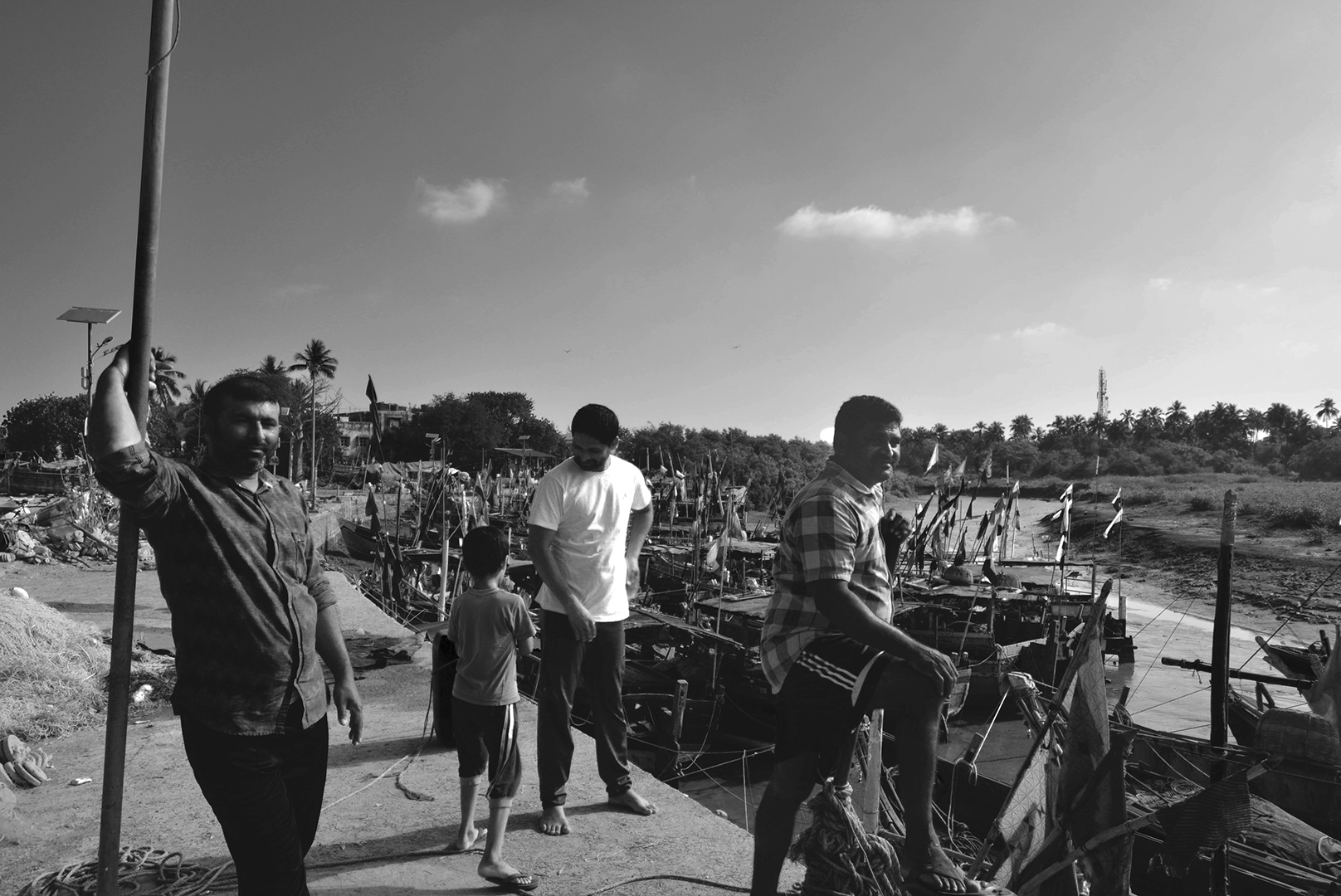
Fishers waiting for the arrival of high tide to leave for fishing Paplet (Pomfret) locally.
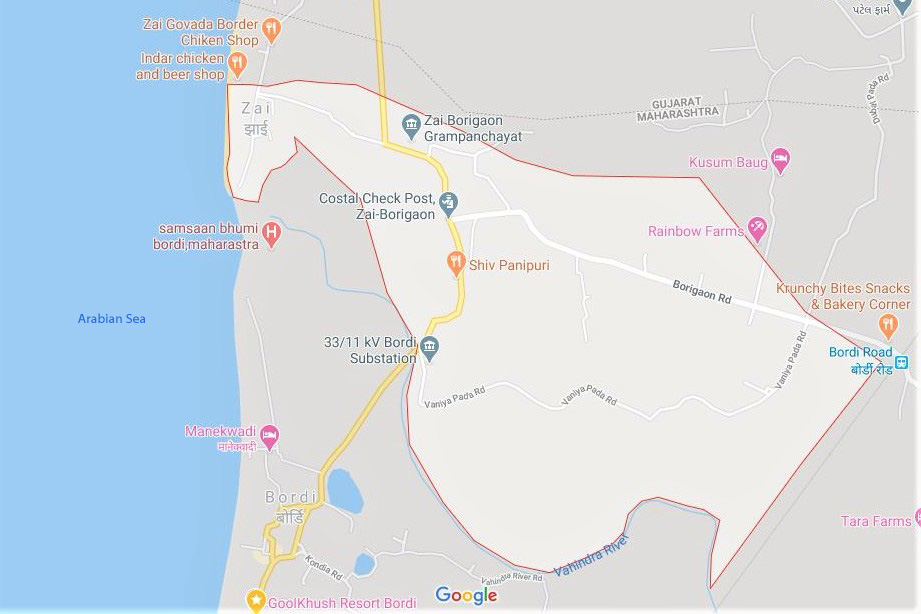
location. This screenshot gives a visual perspective into Zai’s geographical
Source: Google Maps. (2020, June 4).
A Ship Full of Gold
The geography of Zai has contributed to its societal setting from time immemorial and shaped the collective knowledge of the community for navigating the sea as a second home. The area inhabited by the fisherfolk is connected to the mainland by the Zai Khadi Bridge. Zai has the Arabian Sea on the west, the Vahinda River forming a delta on the south which goes around Gujarat and takes a U-turn to meet at the delta again, cutting the land on the east. This has caused a number of problems such as accessibility to education and basic necessities before the construction of the bridge. Northern Zai is marked by the state border between Gujarat and Maharashtra.
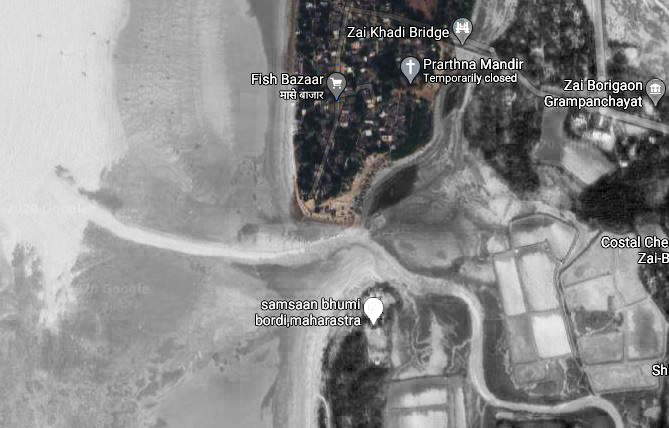
This screenshot from google maps shows a satellite view of the Delta formed by the Vahinda River in the centre. The Zai beach facing the Arabian Sea is on the left and the coloured section highlights the focus area.
Historically the geographical position of the village made it inaccessible by land thereby providing a suitable site for smugglers to offload and transport gold and electronic items in the middle of the night. All of the community members who were approached confirmed that a portion of the RDX for the 1993 Bombay Blasts was smuggled through this tiny coast although the author could not find any official records stating the same. Another interesting element contributing to the oral history dated back to the early 1900s which documented a ship full of gold being washed ashore. The smugglers had promised a gold brick in exchange for the community’s cooperation. All the members eventually agreed but one managed to slip the information to the authorities. The police showed up at the village armed, and three people lost their lives in the ensuing firing. The event is said to have transpired in a single night’s duration. One of the community members (preferred anonymity) father was injured and was taken to jail for conspiring against the state with multiple other people. No living community member can vouch for the accuracy of the happening, although everybody agrees on the occurrence of the event.
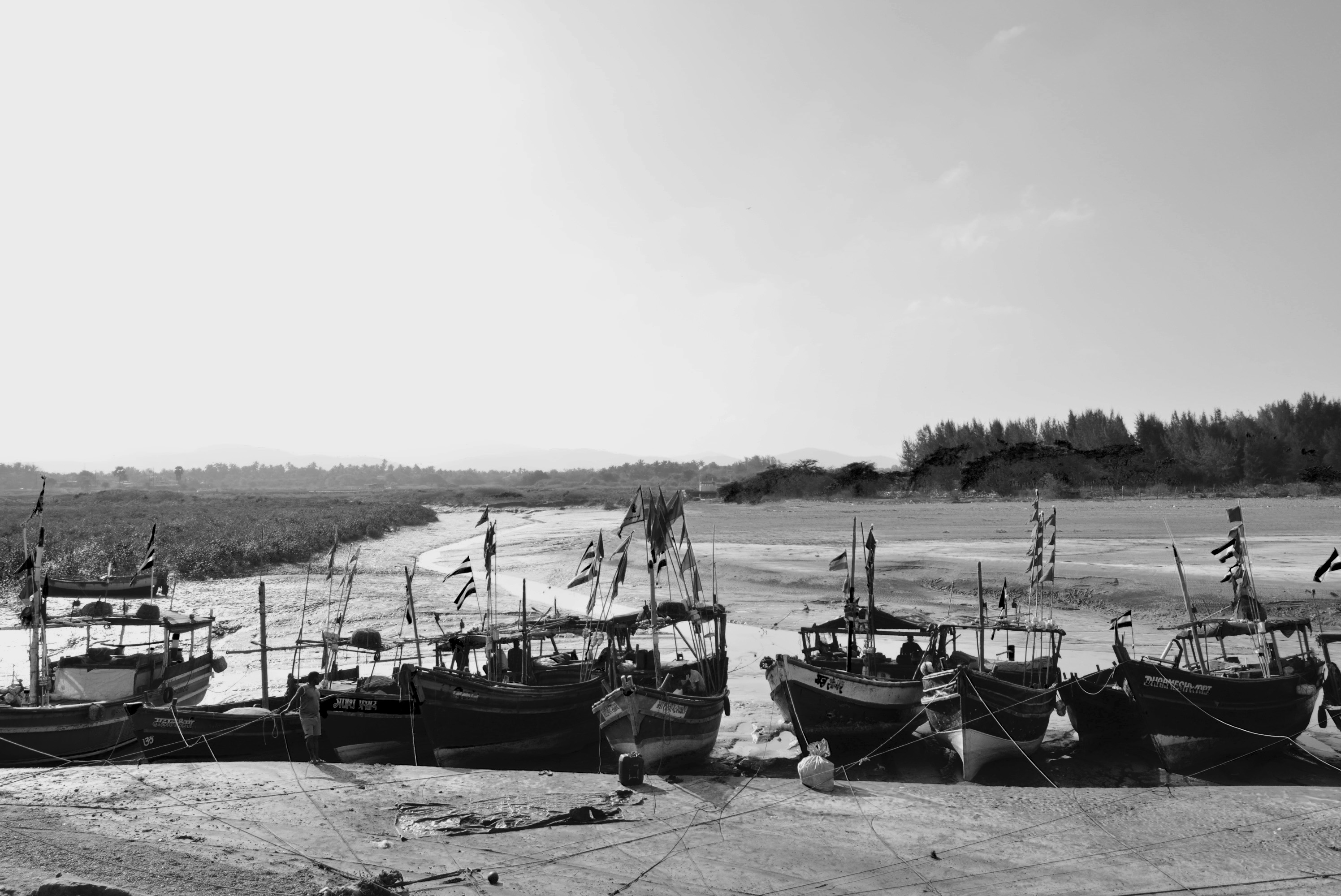
The Vahinda River forming a delta in the background.
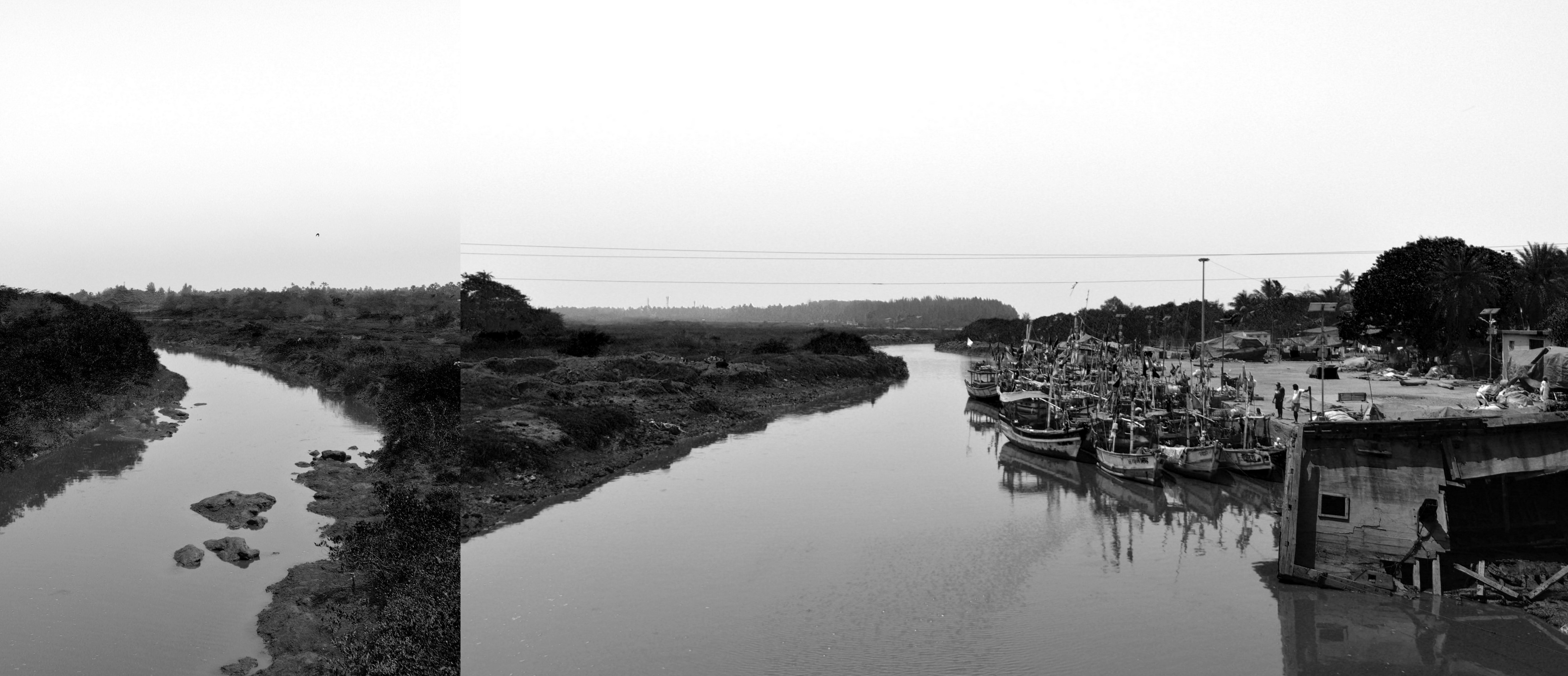
From the left: The Vahinda river on the north of the Zai Khadi bridge, Vahinda River on the south on its way to join the Arabian Sea.
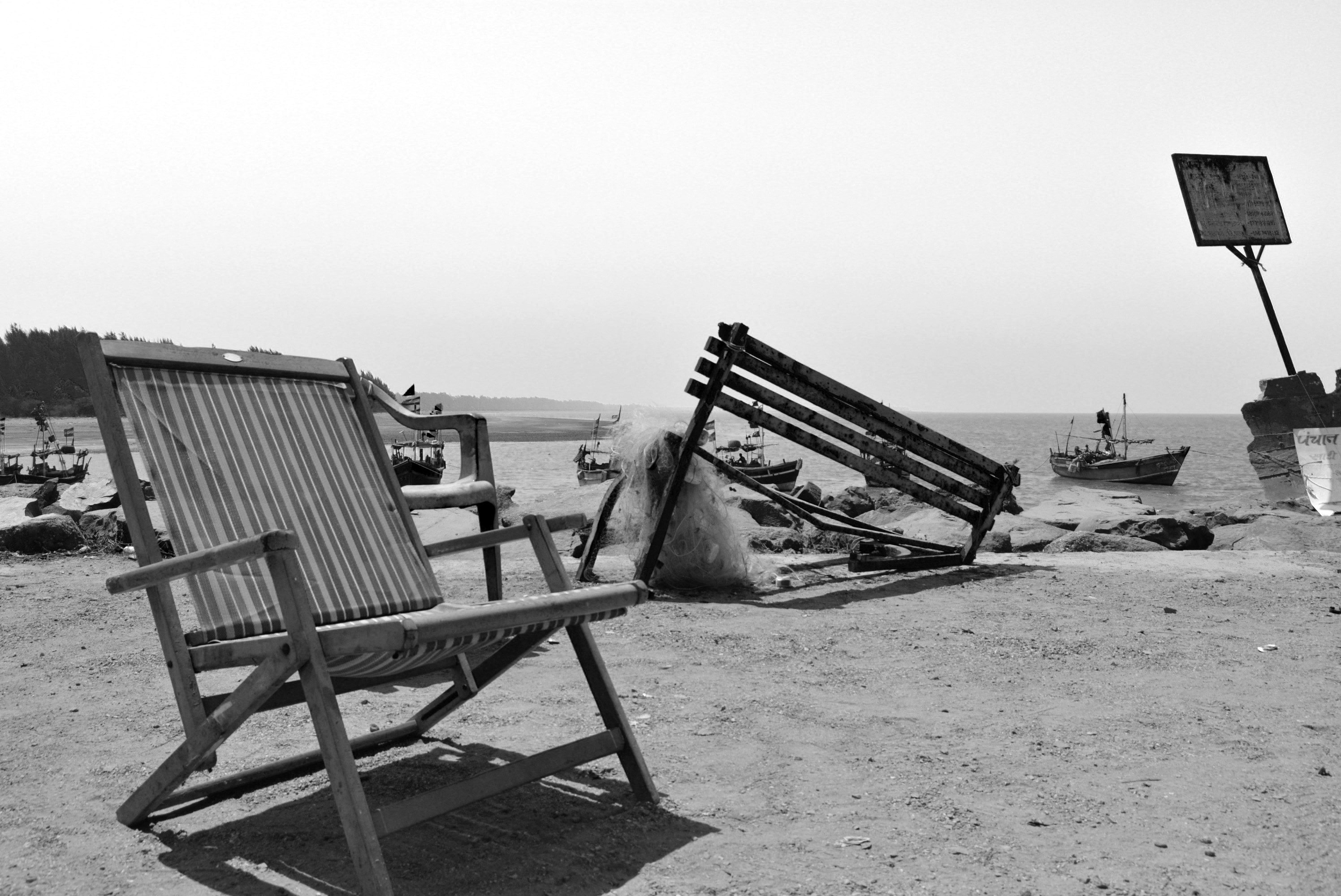
The Zai shoreline during a summer afternoon.
From Two Boats to Two Hundred
At first sight, the village of Zai comes across as a peaceful land inhabited by fisherfolk barely showing any evidence of its past scarred by alcohol abuse. A senior local journalist, Achut Patil, said that in 1964 Jeevanbhai Tokya brought the concept of motorised boats to Zai. Although from the 1960s to early 2000 the manufacturing and sale of alcohol was the main source of livelihood. The hardship of inheriting poverty and not being able to provide enough for one’s family left the village in a sombre shadow. The members who grew up in the said environment narrated incidents from their childhood stating the absence of care, nourishment, electricity and the unavailability of bare minimum medical facilities. The ‘island’ was visited by the Swadhyaya Parivar (Pandurang Shastri Athavale/Dadaji) in the early 2000s and the community feels that stability and interpersonal growth were promoted during their spiritual intervention which changed the village’s abusive landscape. Rajesh Majwelker, the head of Swadhyay Parivar in Zai, said that hardly five to twenty people out of every thousand consume alcohol at present, although Zai does have a beer shop for visitors. Currently, there are about two hundred motorized boats in Zai used for fishing. However, a majority of the community members do not want their children to follow suit as they barely earn enough. The community promotes and encourages higher education if monetary resources allow them to.
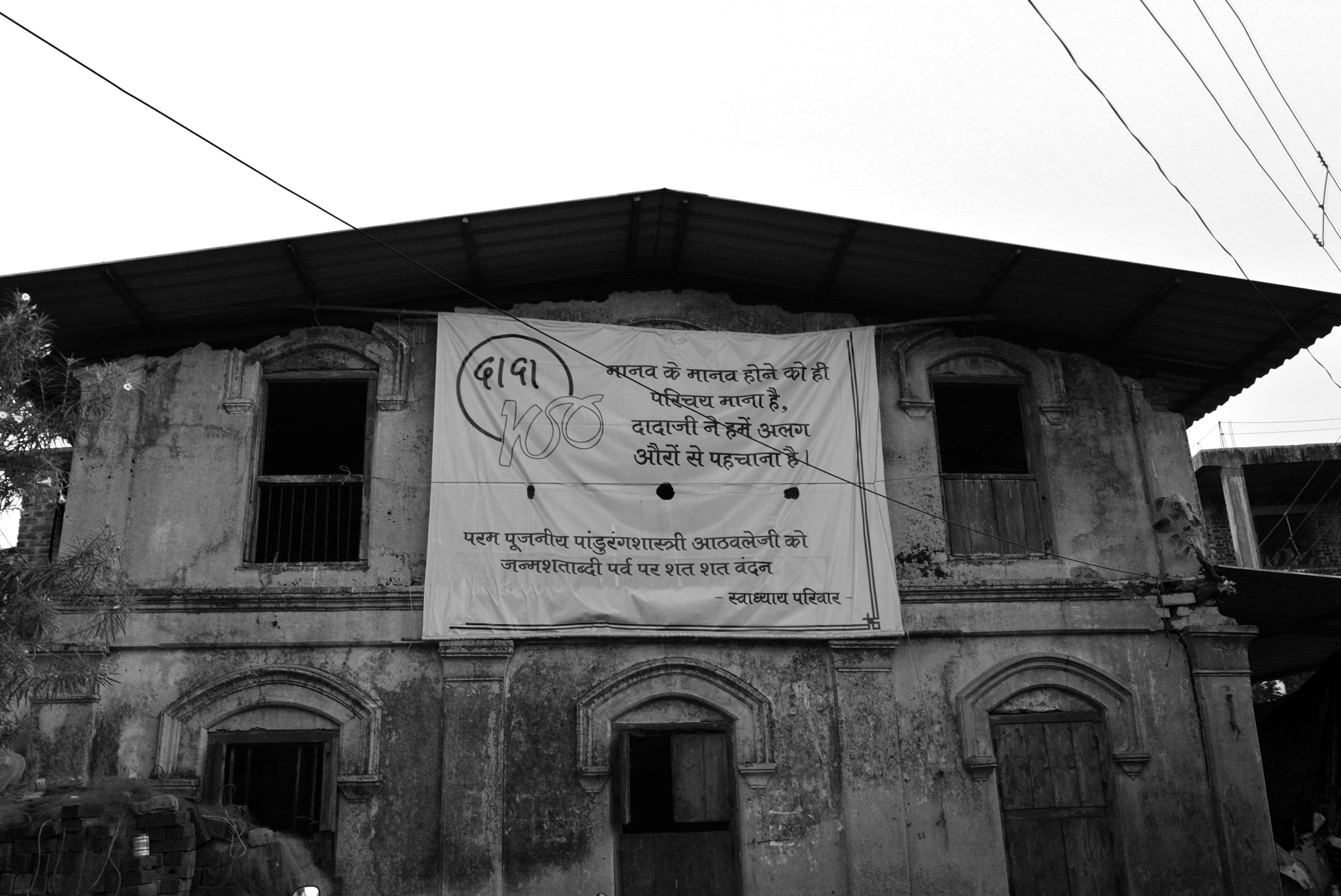
Translation from top to bottom: Dada (brother) has recognised us as a human is recognised for being a human, We humbly bow down a hundred times before our dear dadaji Pandurang Shastri Athavale on the auspicious occasion of his birth anniversary.
Low-Tide Activities along the Coast of Zai
Intertidal Movement along the Coast of Zai
The intertidal zone in the Palghar district exposes a wider continental shelf as compared to the rest of the shoreline in Maharashtra. The daily routine of the community is governed by tidal movements. According to scientific studies, coastal areas observe a high and a low tide each, twice every 24 hours and 50 minutes (semi-diurnal tidal pattern) which gives 6 hours and 12.5 minutes for the water at the shore to go from high to low, or from low to high (National Ocean Service & U.S. Department of Commerce, n.d.). A series of interviews with the local populace revealed that it is during these six hours of low tide that both male and female members of the community go further into the continental shelf on foot to where the stationery nets are fixed. Both male and female members of the community engage in this type of fishing. The fishermen leave for three to five days into the sea for local fishing of Paplet (Pomfret), Lobster and Bhing (Hilsa) when the high tide comes in.
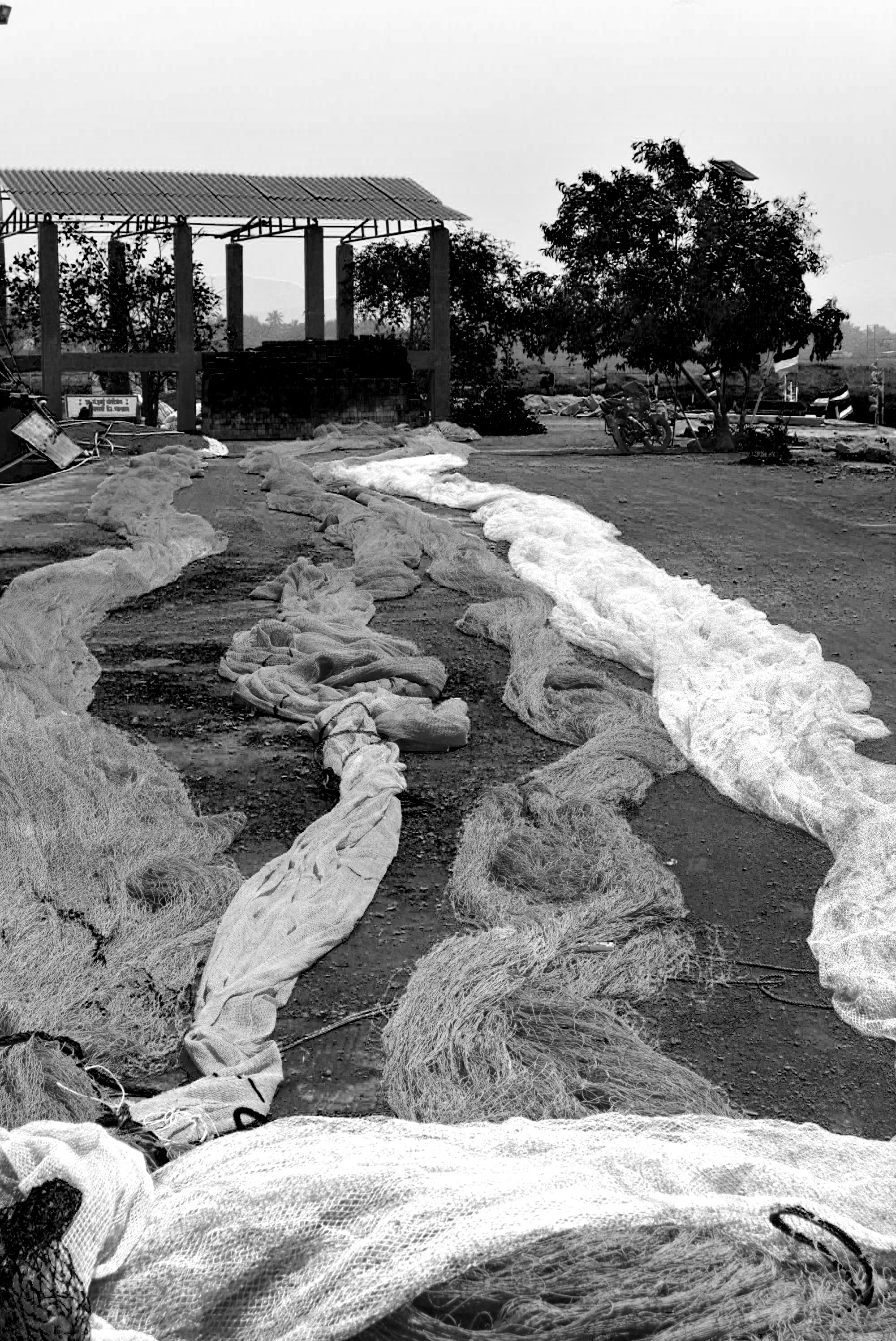
A batch of stationery nets set to dry in the sun.
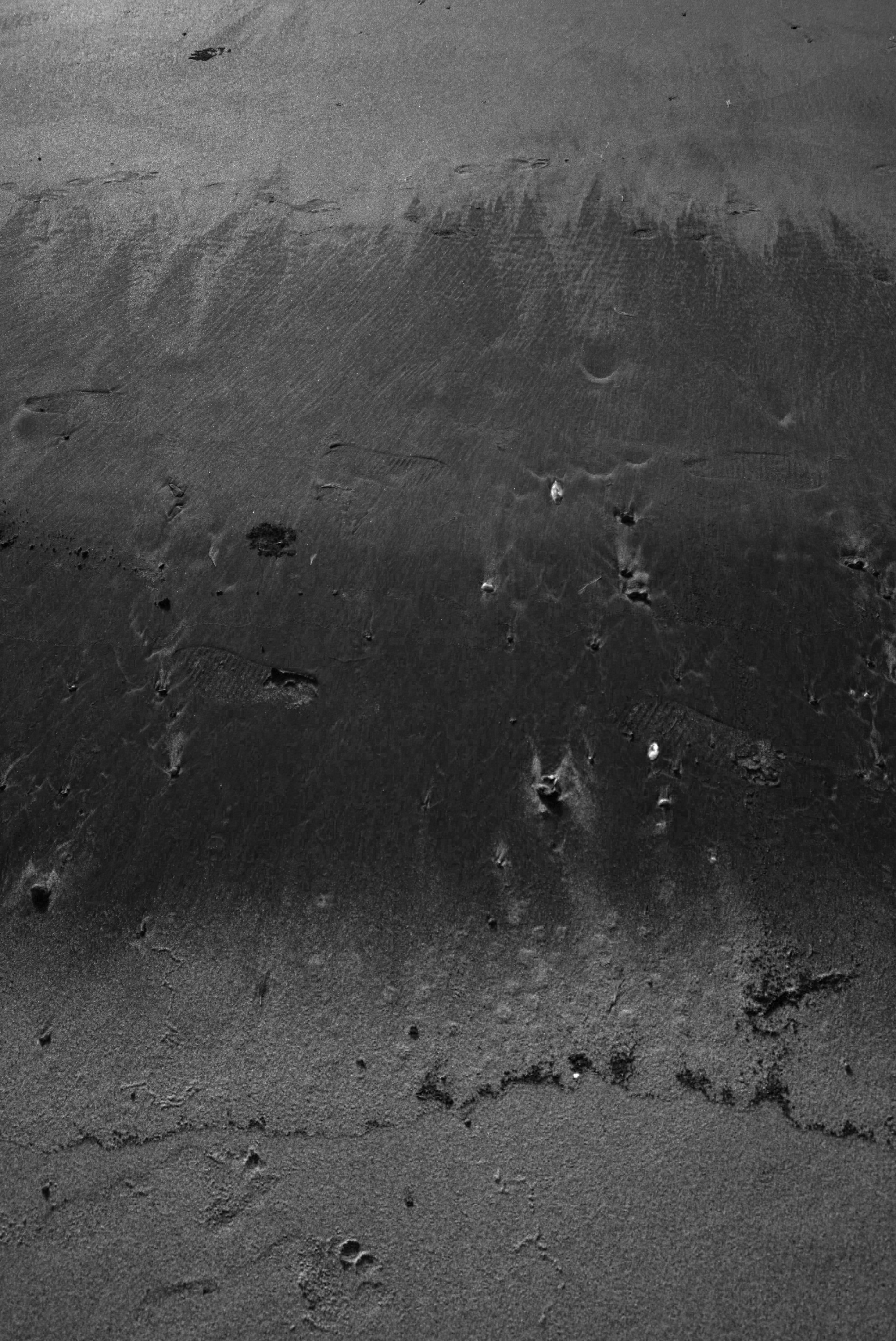
A closer look at the low-gradient muddy beach and intertidal sand platform at Zai.
Occupational Culture
The people of Zai speak and understand four languages — Gujarati, Marathi, Hindi and English. Their life is governed by the tidal charts, the seasons and the sea. If you happen to visit the village, the fisherfolk will invite you to have lunch with them. A plate of fish curry cooked in imli (tamarind) or kokum (Garcinia Indica) or a masala fried fish served with rice makes for the staple diet. For the fisherfolk of Zai their life is their work. If the high tide comes in at three in the morning, they will leave home at 3 a.m. and with them the entire family will dedicate themselves to the process of bidding farewell. A majority of the fisherfolk started fishing as a way of taking forward their ancestral practices. Some of them get used to the sea in a couple of weeks, but for some it takes more than a couple of years. Most of the fisherfolk cannot recall when they went into the sea for the first time. A few of those who remember, either remember it as an unforgettable pleasant experience or as one of the scariest things they have faced in their life. The fishermen go into the sea twice a month, every fifteen days for three to five days at a stretch. The women take short fishing trips on foot into the sea during the low tide and have a distinct role of distributing, processing and selling the catch brought in by the fishermen during their long trips. When the author asked the women why they don’t join the fishing boats, all of them laughed and replied that the boats don’t have toilets!
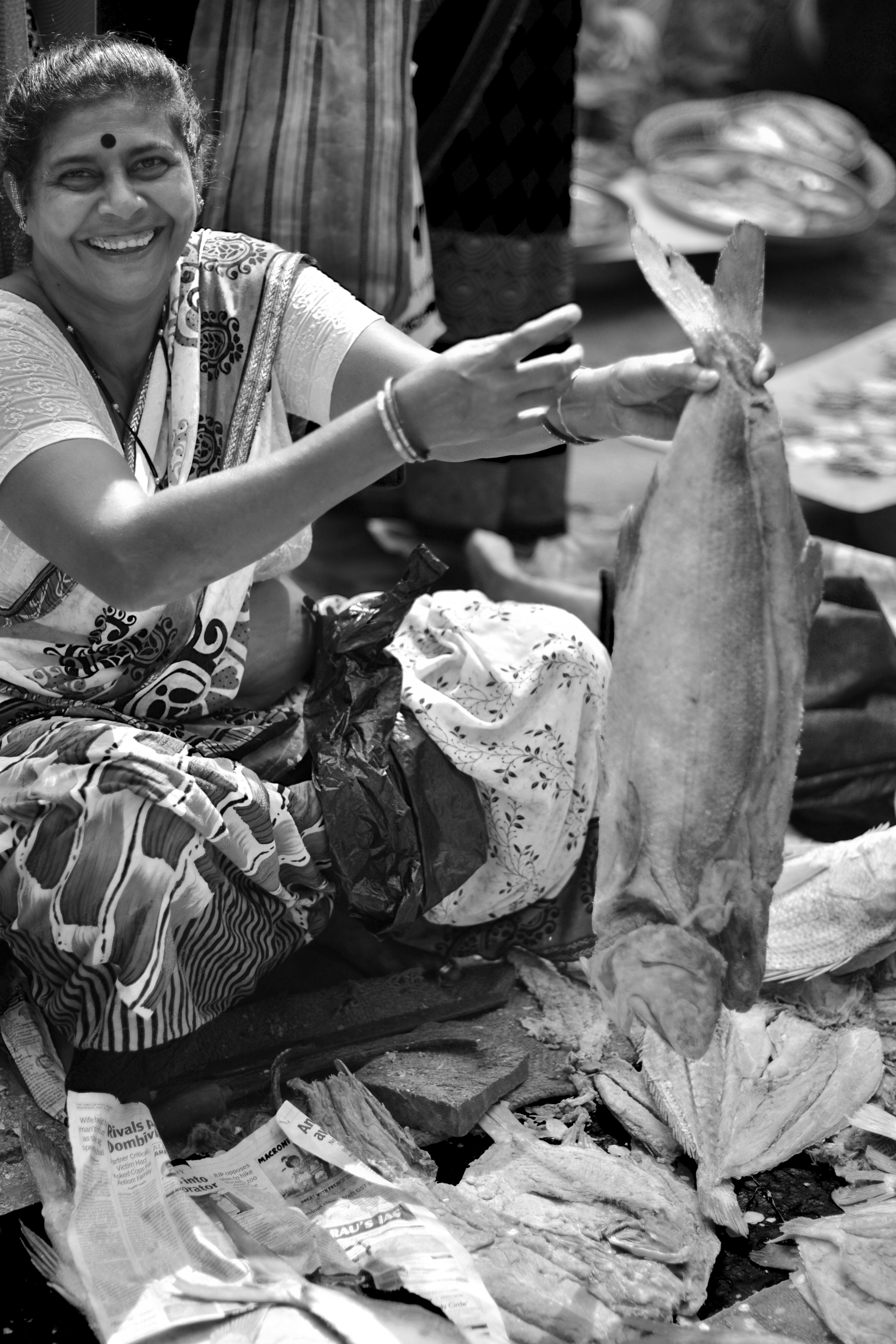
A fisherwoman selling dried Rawas (Indian Salmon) fish in the market.
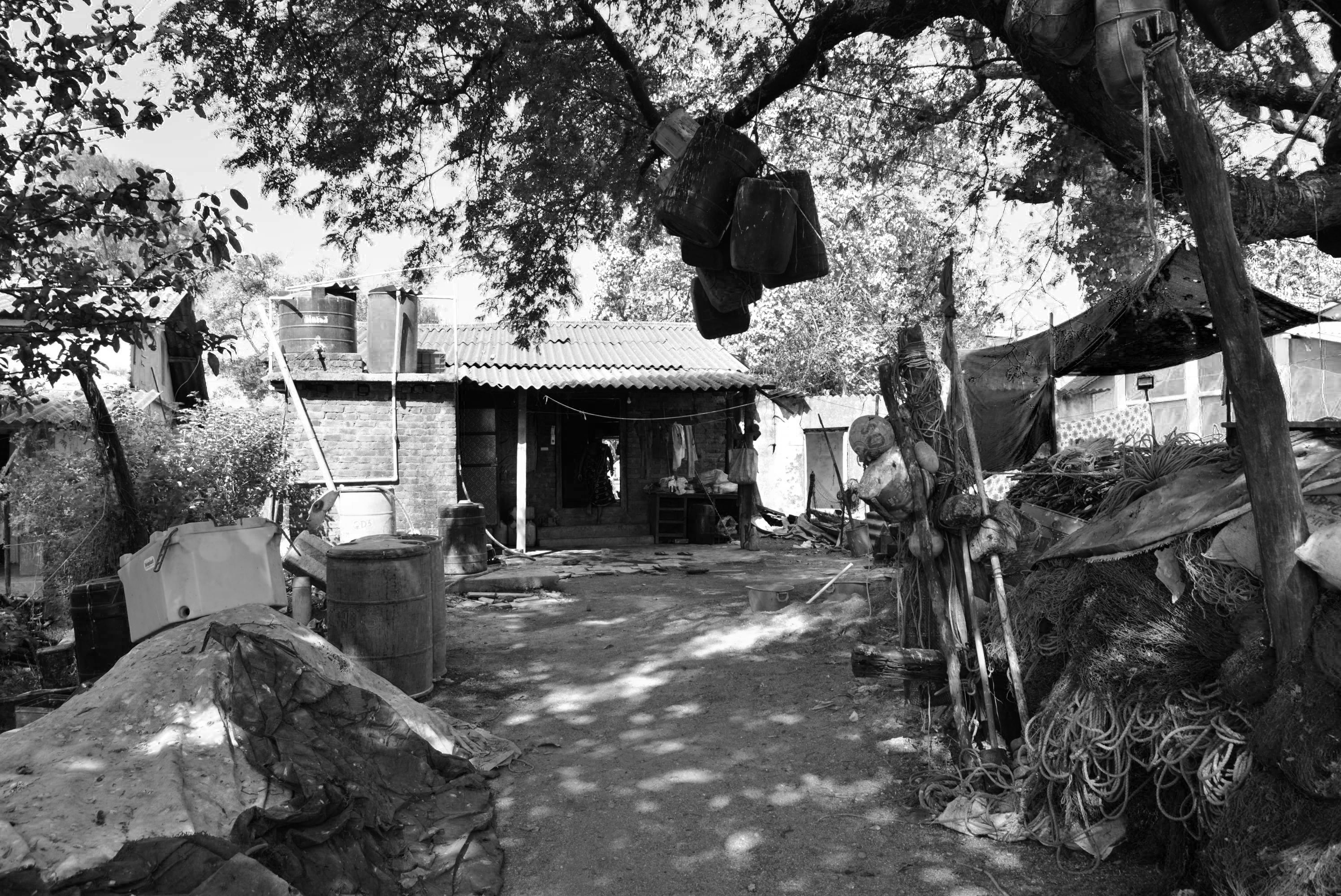
The backyard of a fisher family's home.
Bhagwaan Macchi, talked about his preference for music while they worked. He described how the new age music is more about “dhaap dhoom dhaap dhoom” but he has little say in the matter as the younger members onboard tend to work with a higher energy level when they have it their way. While at sea the fishermen wake up around six in the morning and the first thing they do is check the GPS to make sure they know where they are. Fishing nets are laid immediately and when it’s not an urgency they prioritize their morning chai (tea) and breakfast. By the time they are done with the nets it is usually noon and time to cook rice and fish for lunch. They start with the nets at 4 in the evening again and wait to catch something. If not, they take a break around 5 to 6 p.m. as they get busy with the nets from 7 to 9 p.m. again. “We prepare our dinner after this and take a final check at the nets and try to sleep. We repeat this for three to five days depending on how long we are at the sea,” says Bhagwaan Macchi as he prepares to leave for the sea.
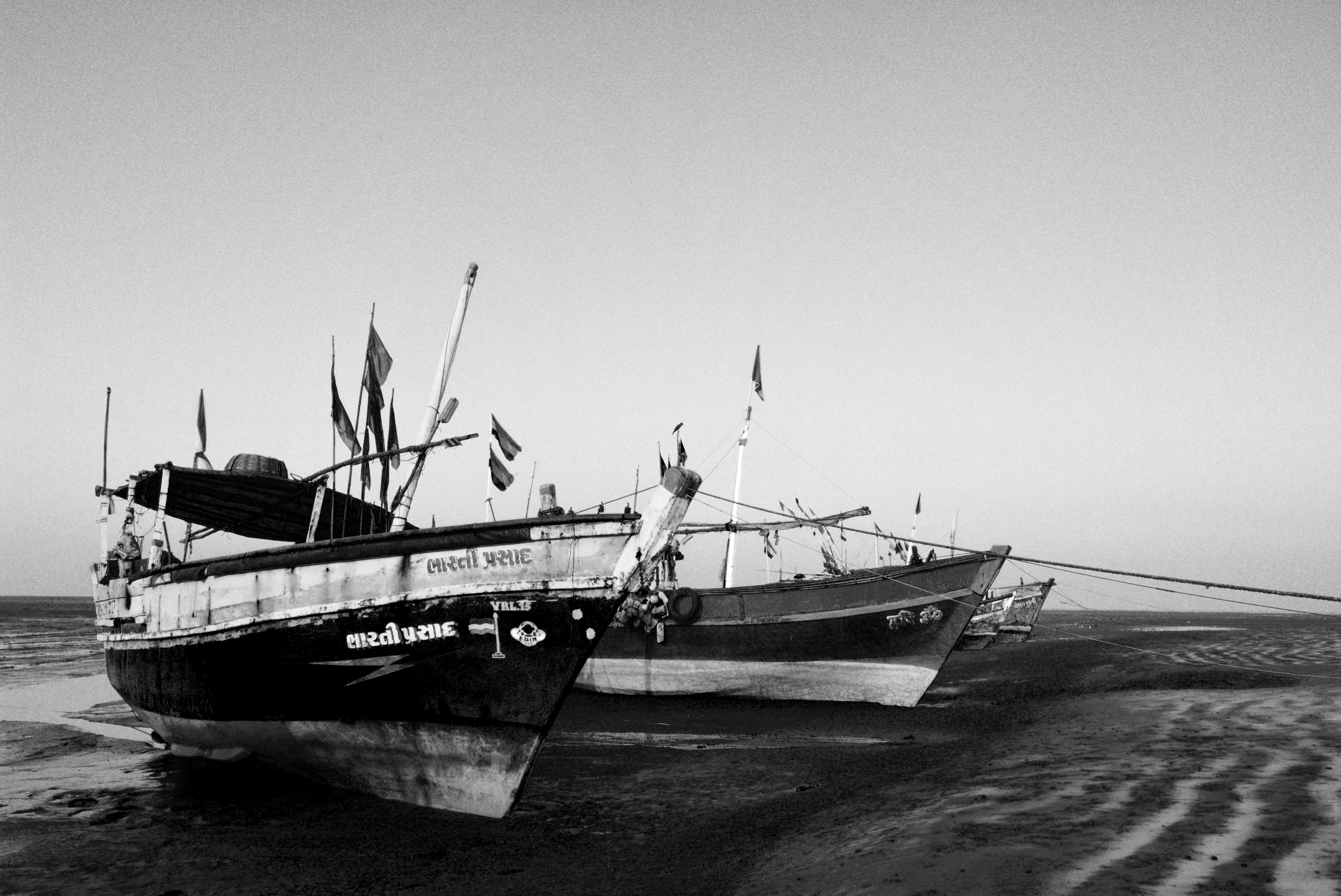
The fishermen outsource their satpati (a type of boat with a medium pointed bow and a broad stem) boats from builders in Gujarat and each boat costs around Indian Rupees (INR) 50 lakhs (5 million).
The fishermen employ various relevant safety techniques to meet the continuous risk of cyclones in rough seas such as anchoring the boat with additional nets. According to the fisherfolk the loan to purchase their boats takes up to five years to be approved. By the time the loan is approved, the boat starts to rot away. In an incident narrated by the fisherman Shirish Macchi, his friend had claimed INR 35,000 as insurance for the damage caused to his boat during the monsoons but ended up spending INR 40,000 in an effort to get the claim approved. He suffered a loss of INR 5,000. Once the boat is in the sea it has to have a license and insurance (renewed yearly) in the same way a car does. They are also required to hoist the national flag in case the navy or the coast guard comes. Although the fishermen don’t use proper flags with the Ashok Chakra as the cloth gets tattered against the wind.
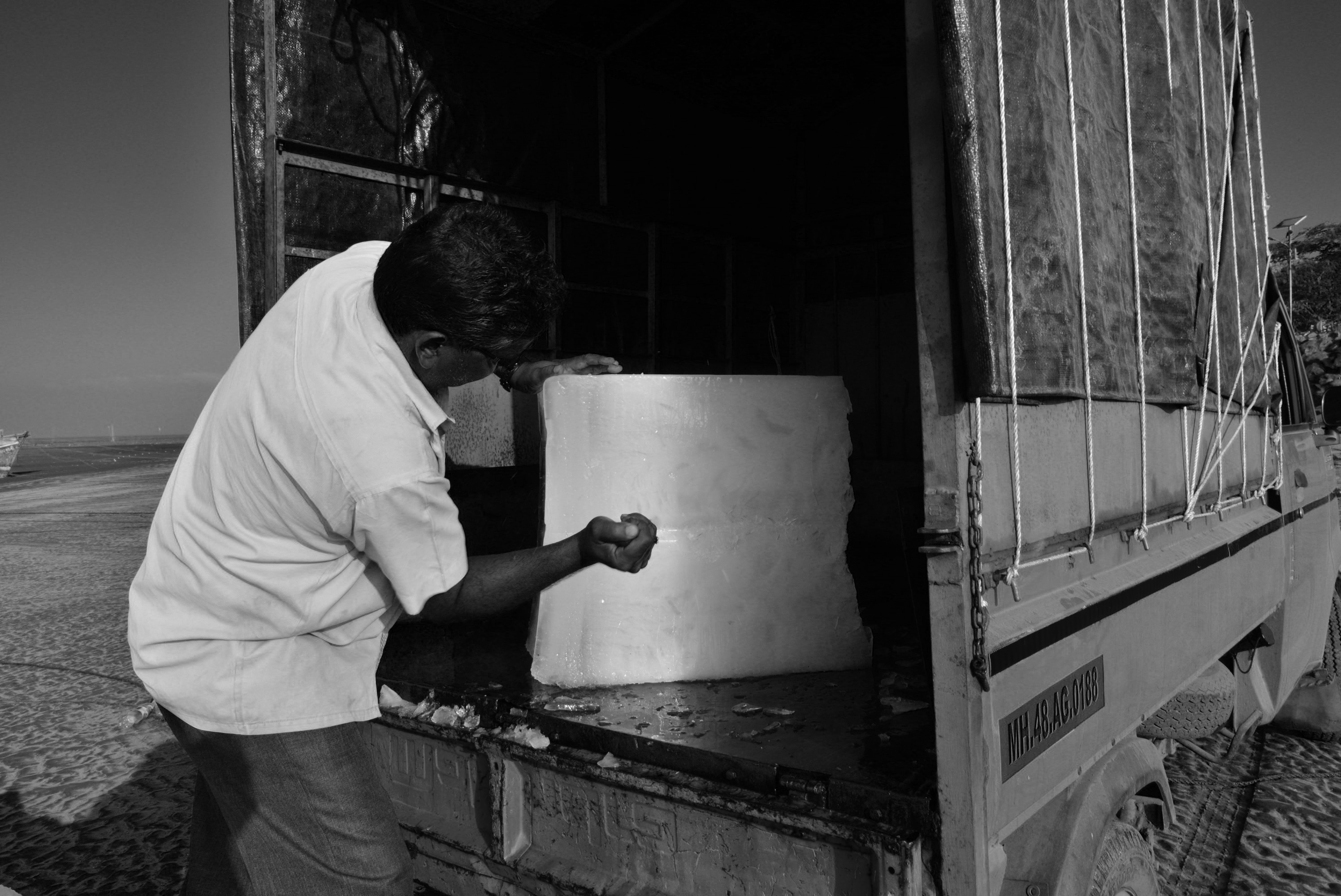
Unloading of dry ice supplied from Umargam, Gujarat as fishers prepare to go into the sea for 3-5 days.
Traditional Knowledge Systems
An abundance of fish causes a change in the colour of the sea and the water appears dense. The fisherfolk keep a track of this so they can catch the fish efficiently. Shubhash Macchi, who has been fishing for more than 20 years, tells me that “We have four fishing seasons — Paplet (Pomfret) which lasts all year, Lobster which lasts from August to November, and Bhing (Hilsa) which lasts only for the month of November. We know which fish will come in which season so we fish using particular nets.” Catching each fish requires a different technique. Lobster is caught by weighing down the nets by using rocks so they touch the sea bed whereas Paplet (Pomfret) is usually found near the surface. The end of the monsoon marks the commencement of a new fishing season every year.
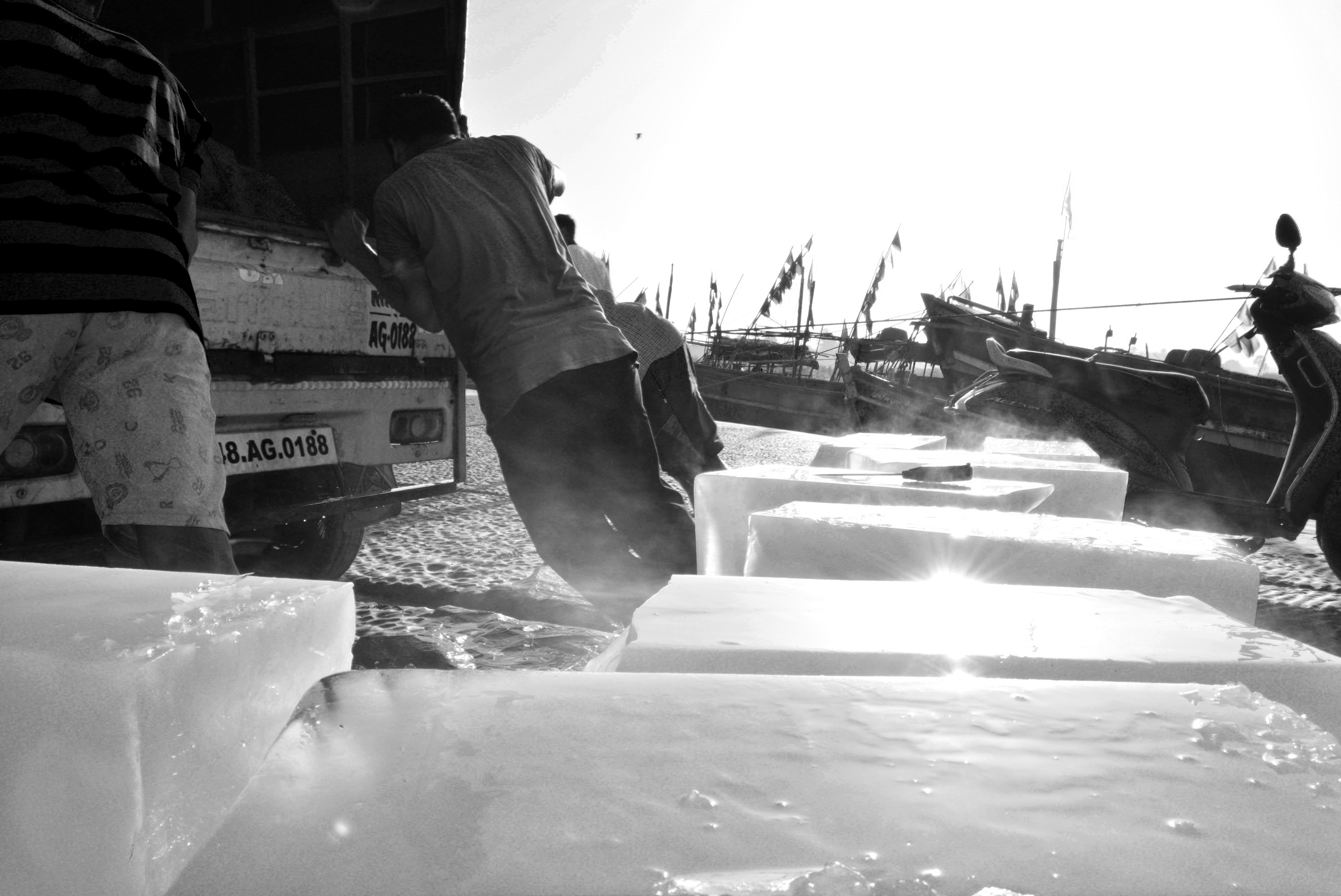
Breaking ice into smaller pieces.
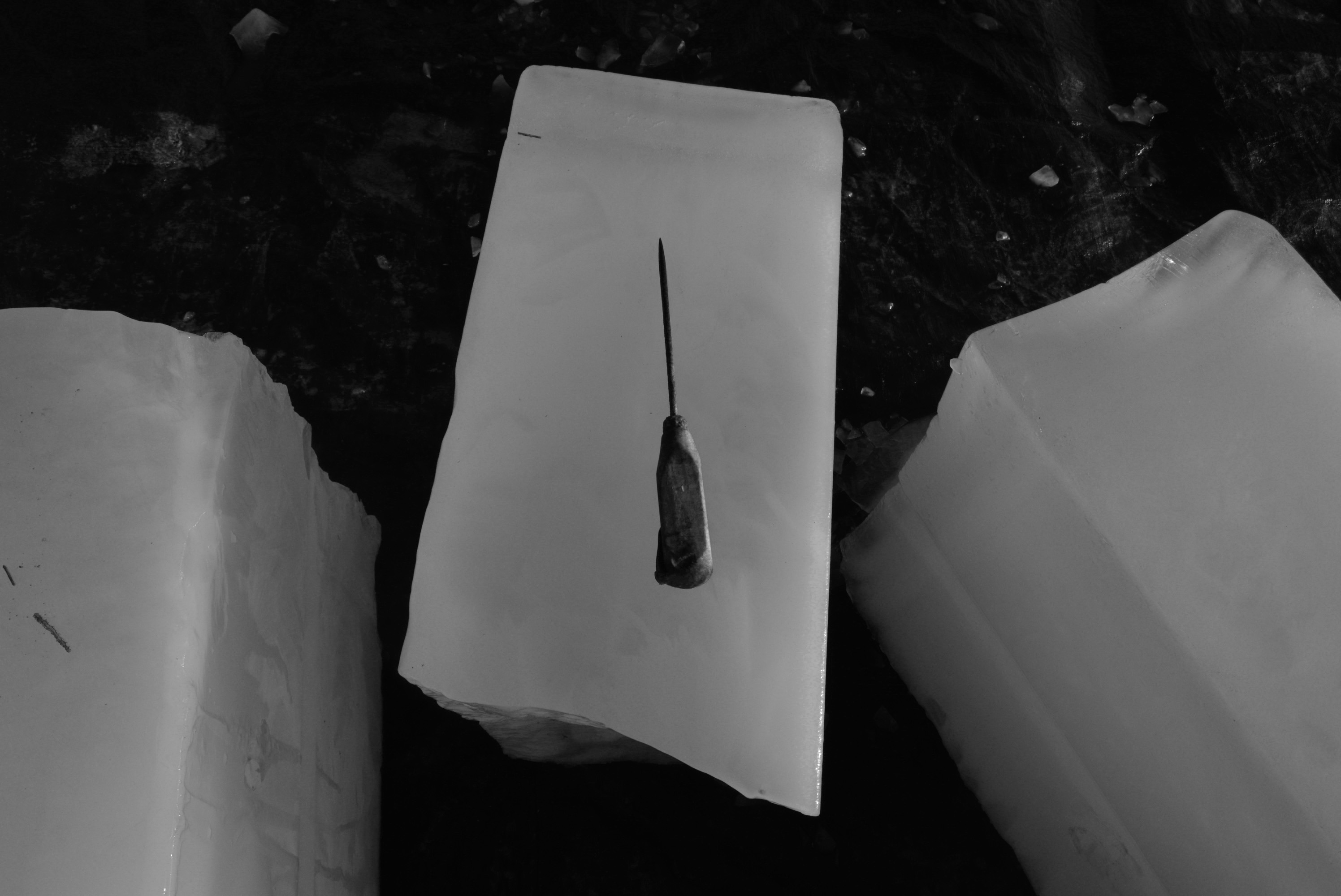
Adaptive use of a screwdriver as a tool to break ice into smaller pieces.
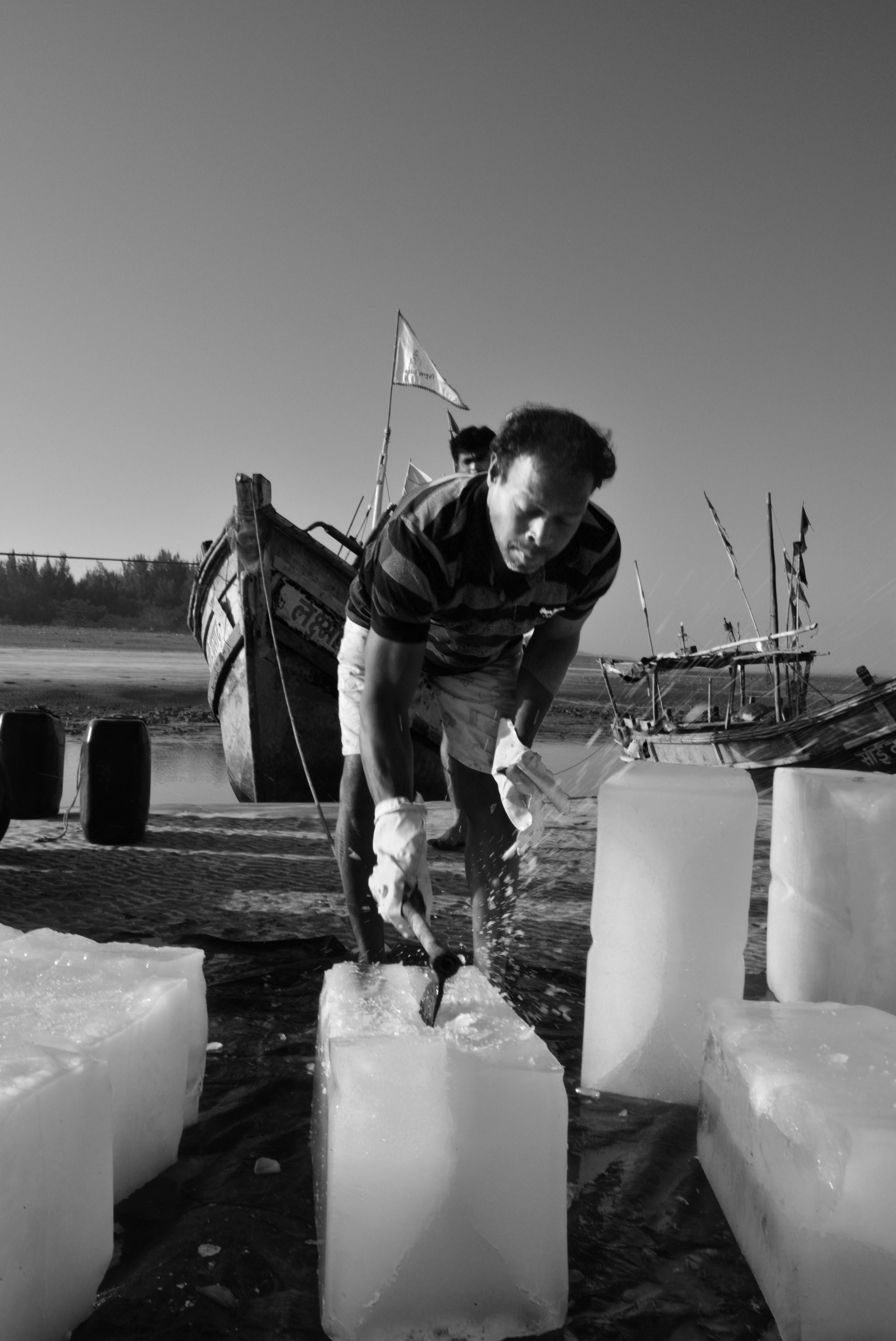
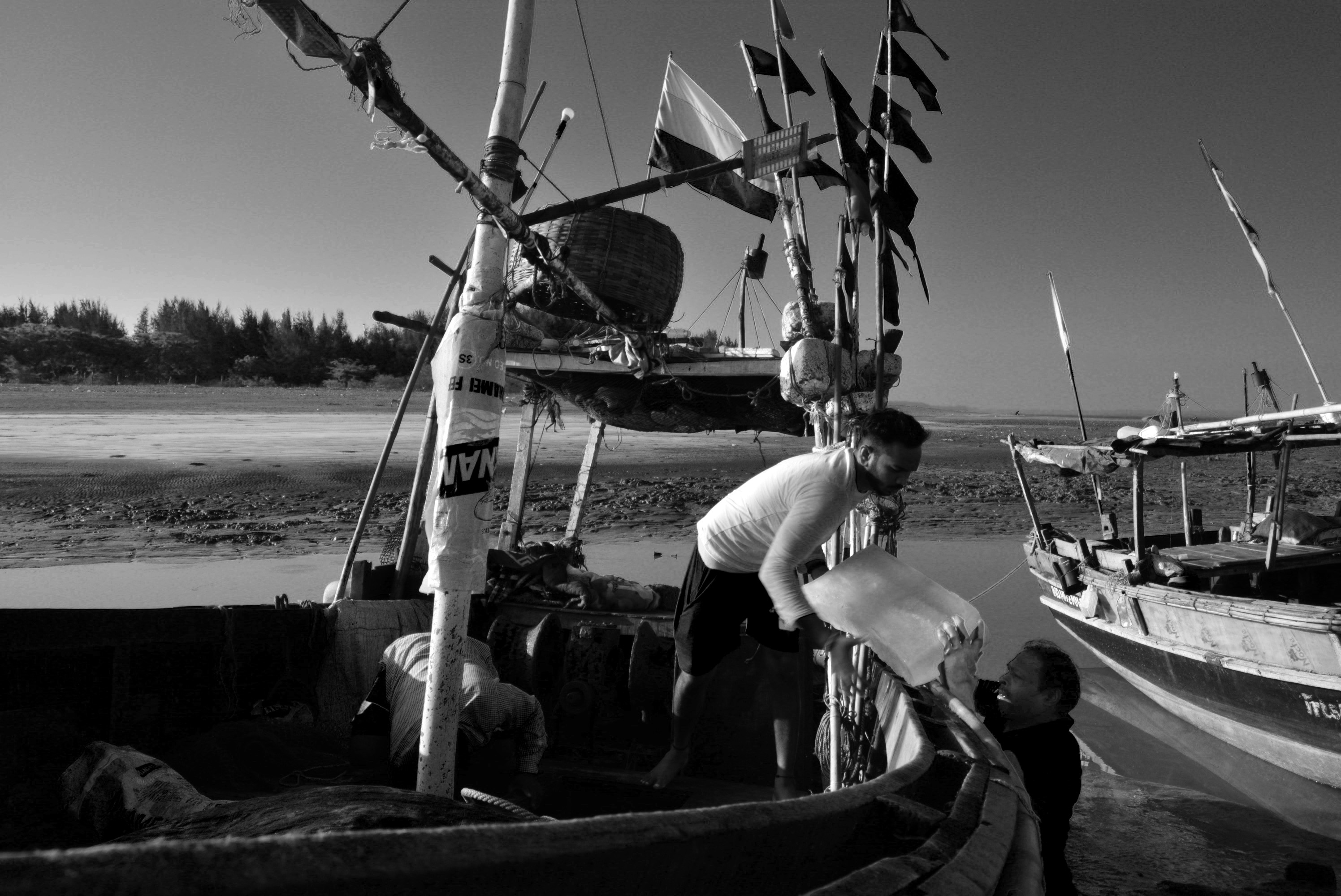
The fishers stock at least 20 kg of dry ice every trip to preserve their catch for 3-5 days.
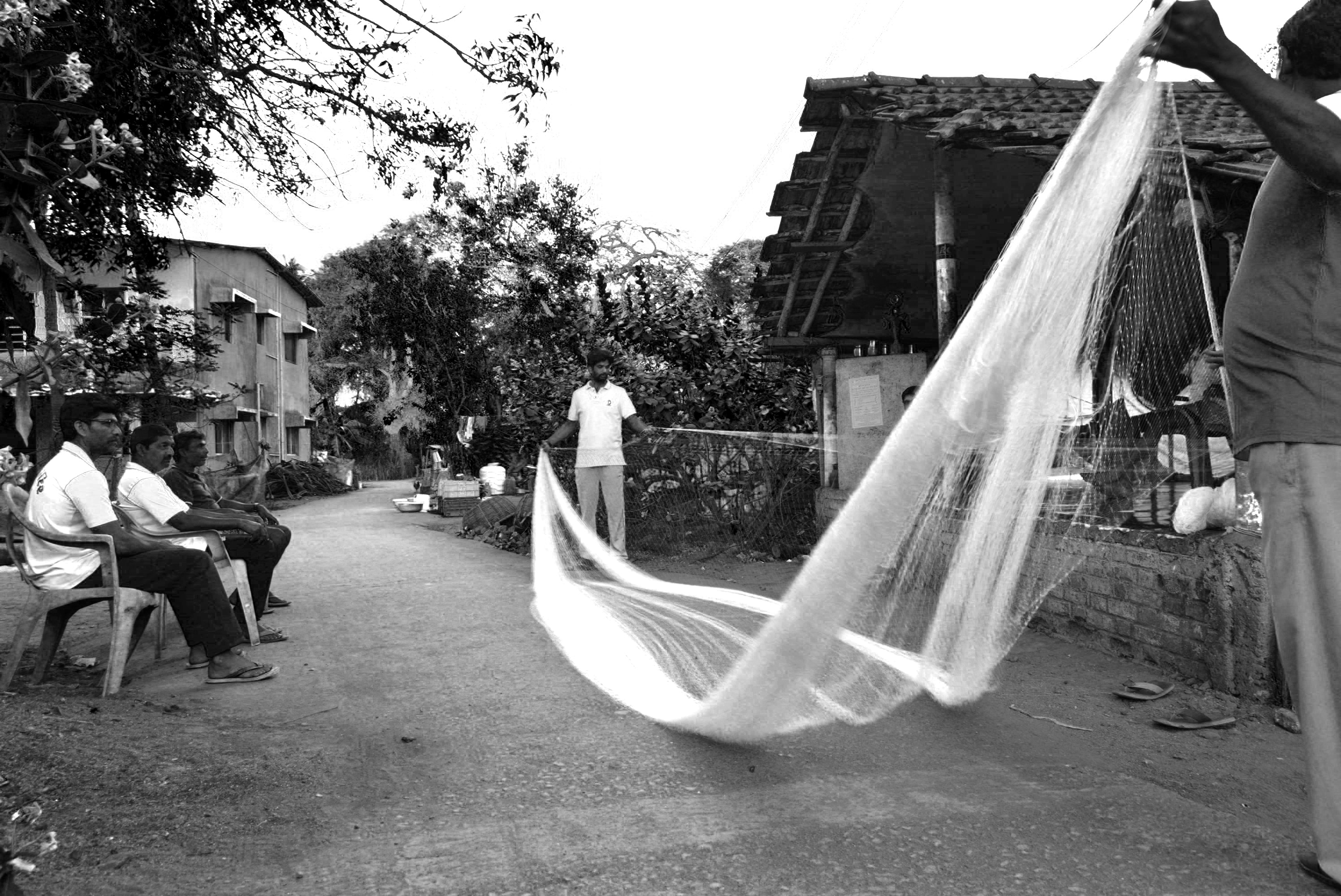
A group of fishers rearranging their fishing nets to stock onto the boat.
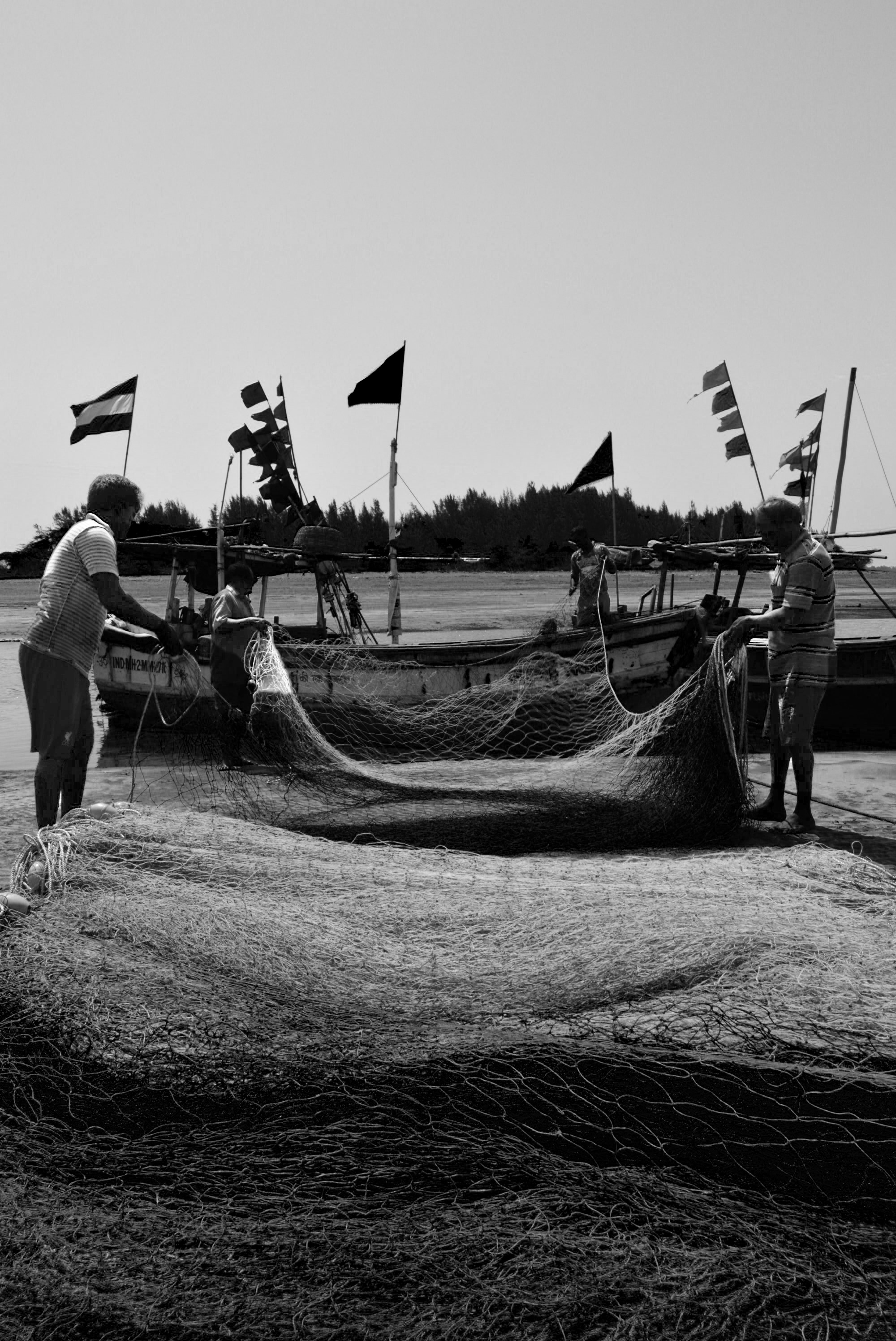
A group of fishers rearranging their gill fishing nets after returning from a trip.
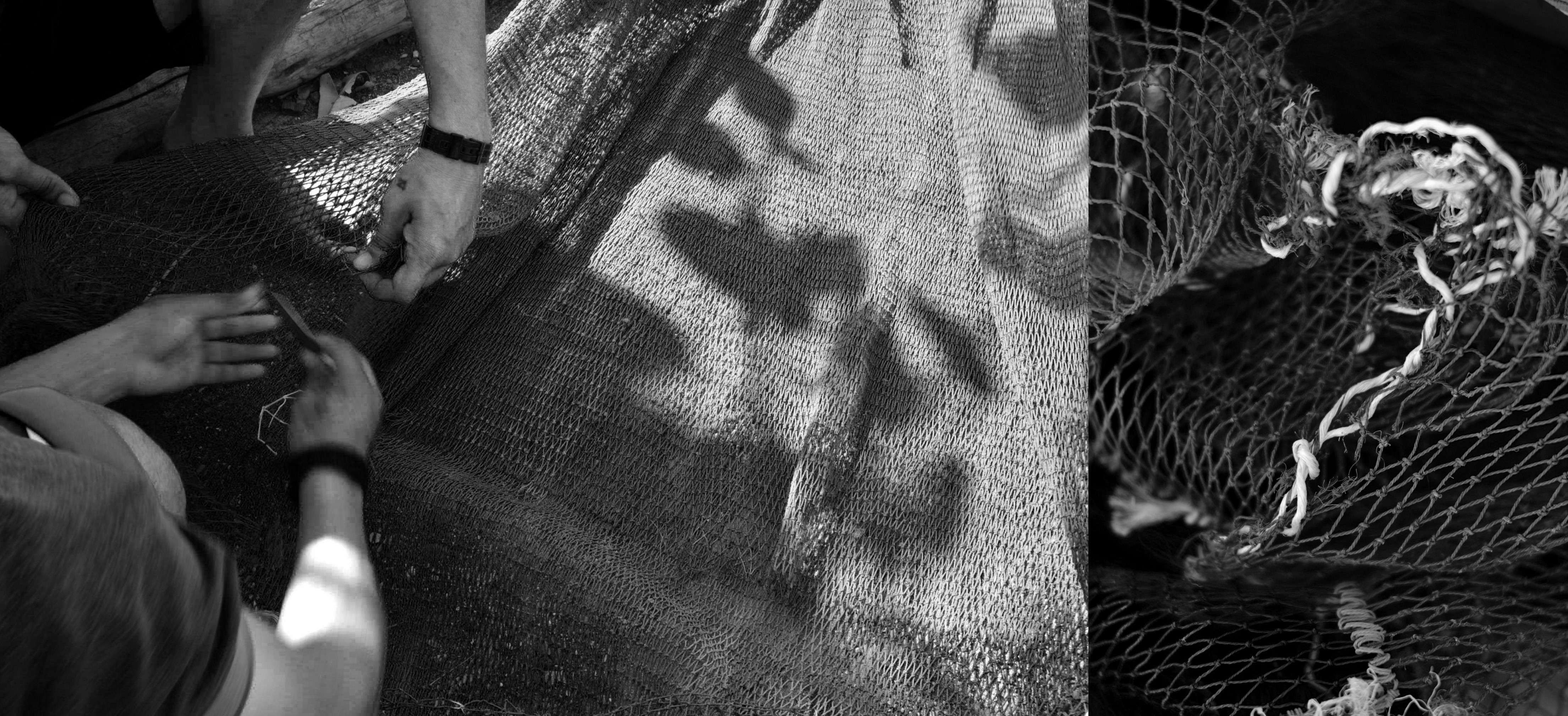
Fishermen mending their nets with nylon thread.
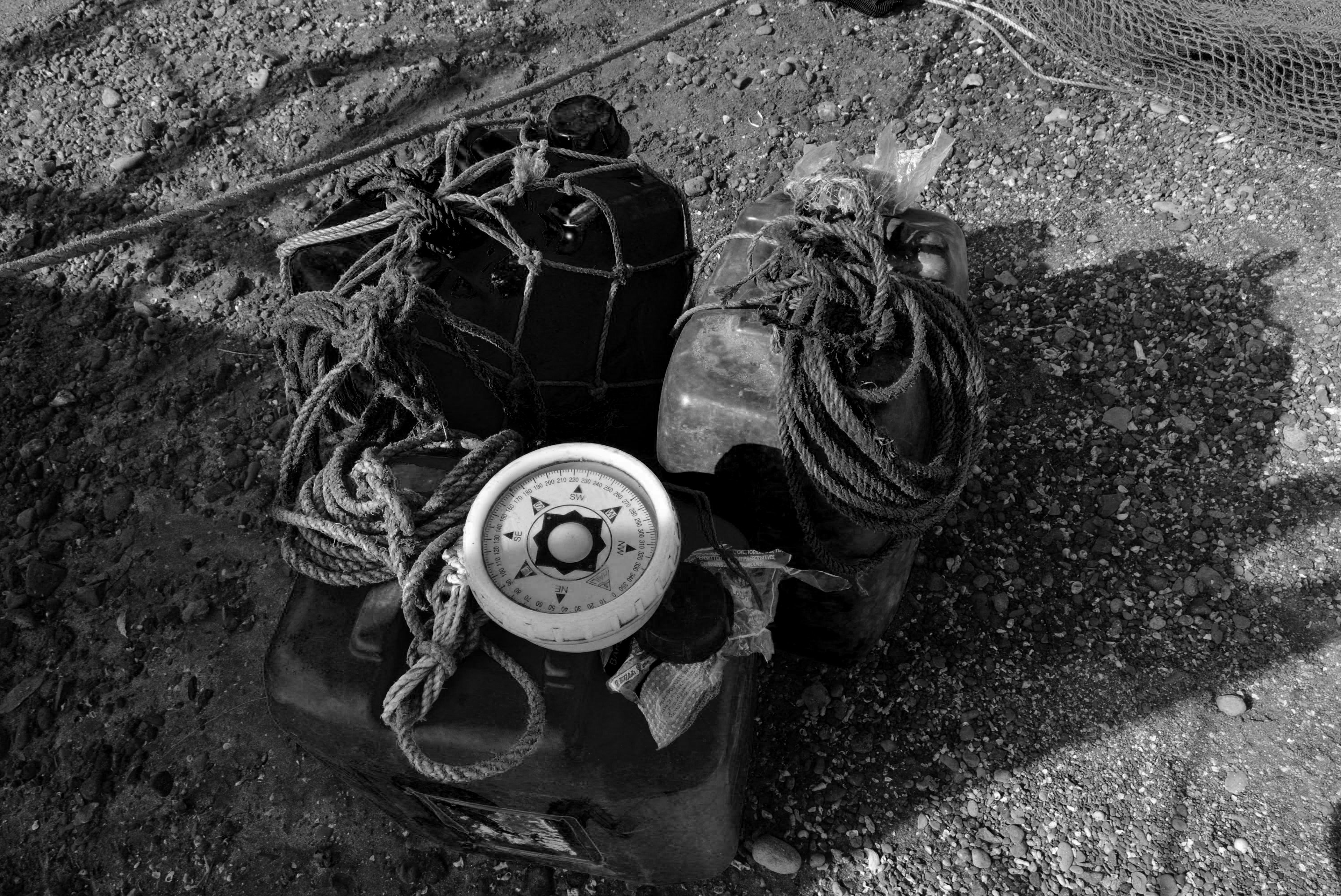
A compass in white used as an alternative to running the GPS continuously in order to save battery. The fishers usually stay in a fleet of 25-30 boats and keep exchanging information continuously to ensure their safety at sea.
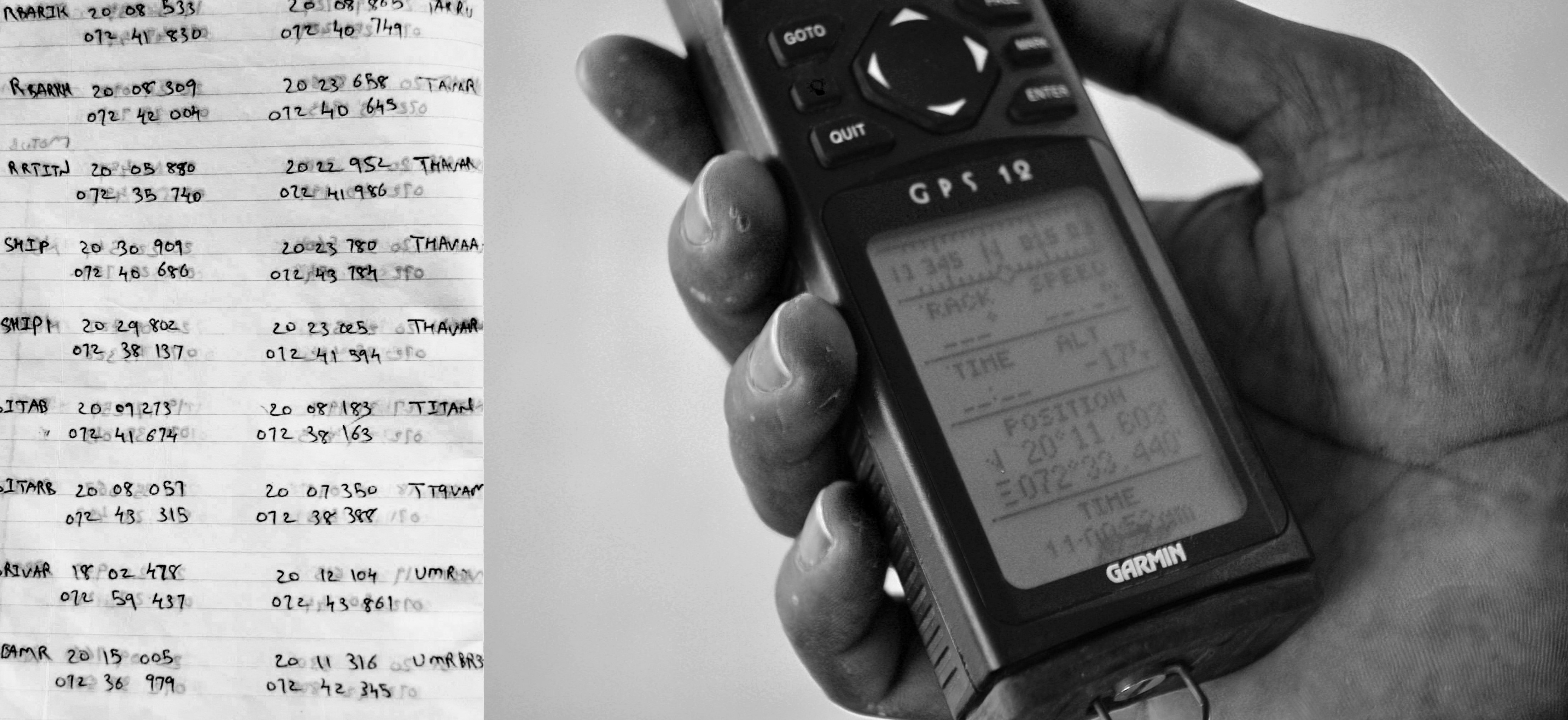
From left: A glimpse from fisher Nikhil Sagar's journal record on deep-sea fishing coordinates from 15 years ago, A GPS currently in use.
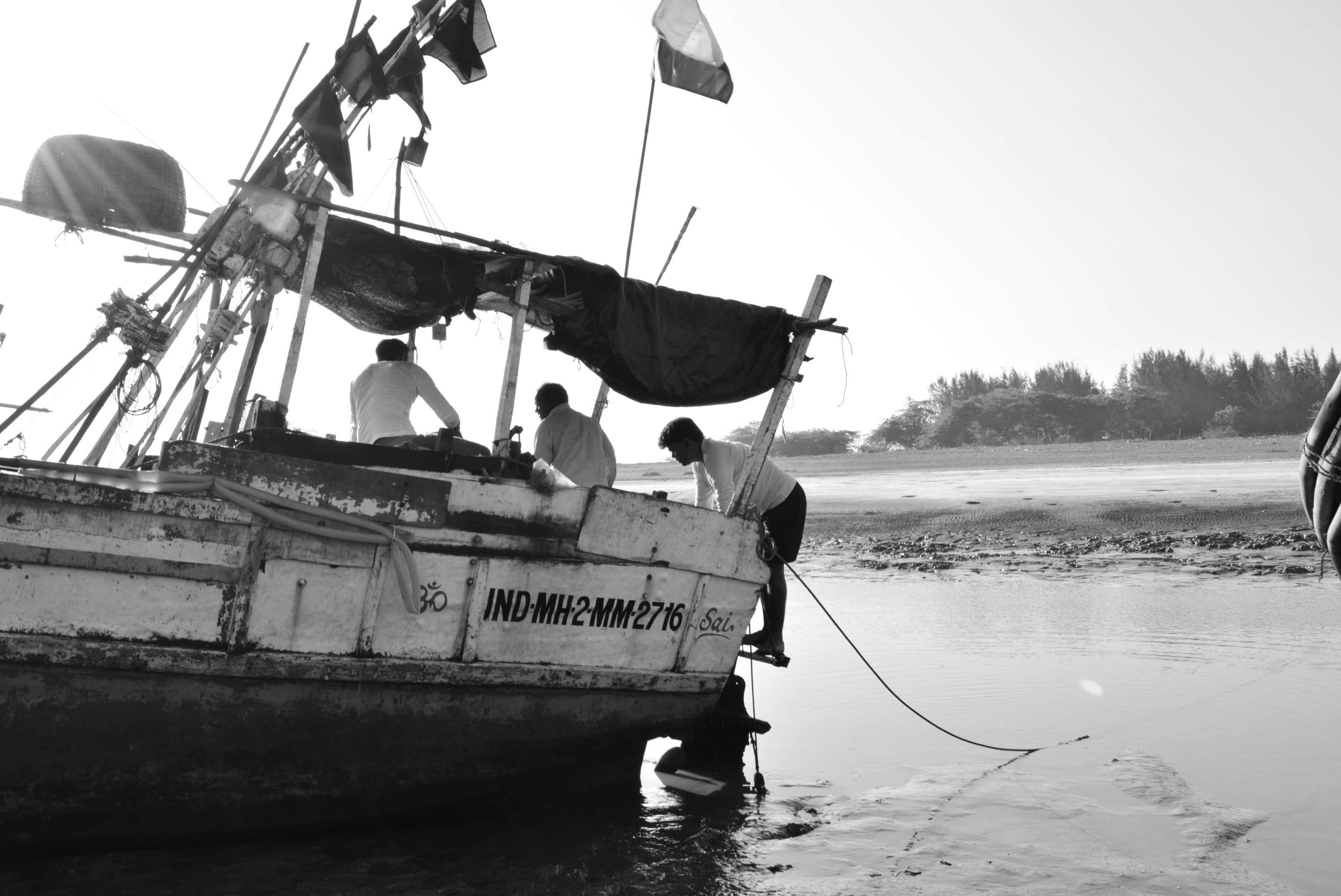
Khalaasi (a term used to refer to crew members on-board) running final checks on the boat engine before leaving for the sea.
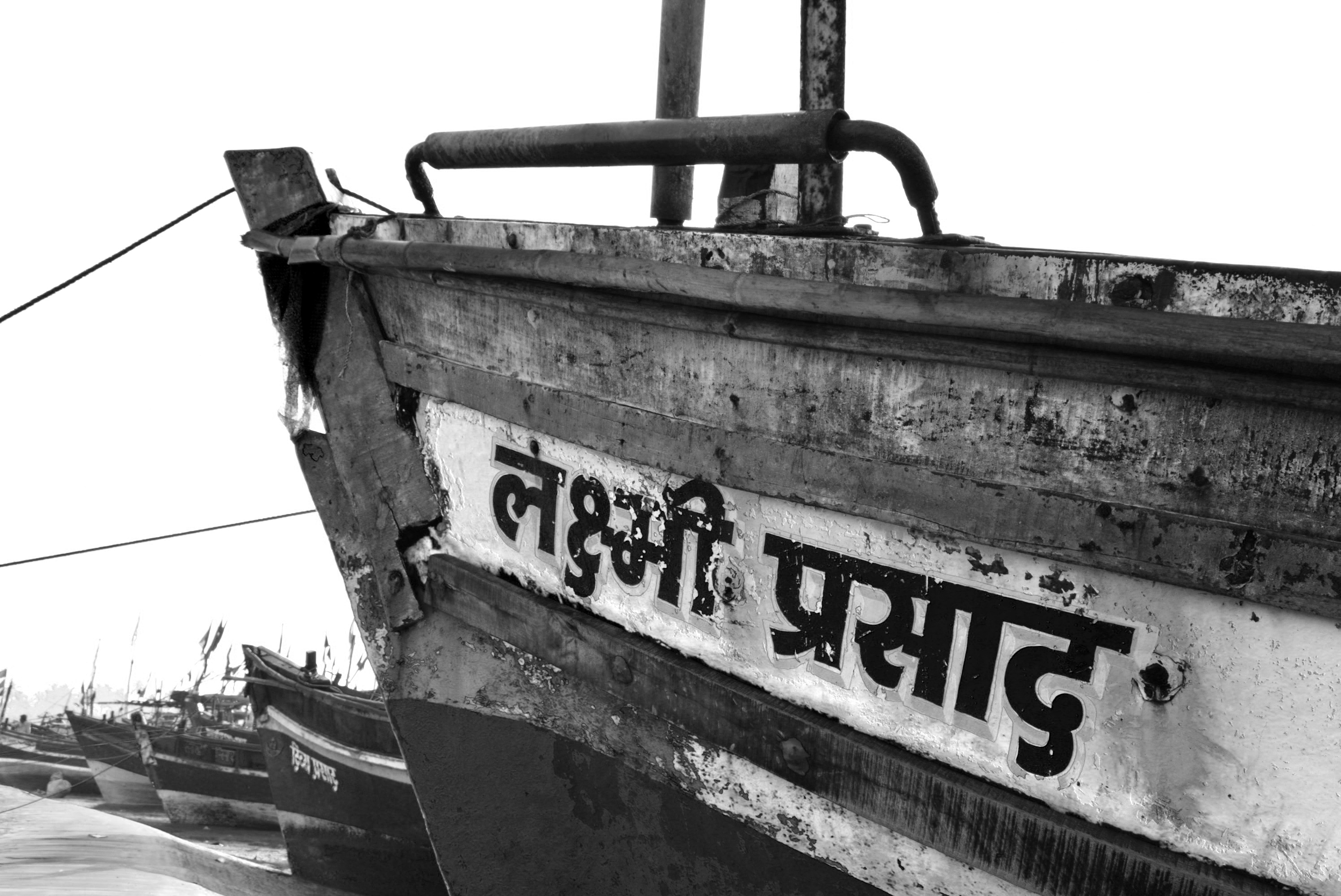
In the local dialect of Gujarati and Marathi 'prasaad' can be literally translated as 'blessing'. The fishers say that the boat helps them earn their livelihood so they take it as a blessing and express the same while naming their boats.
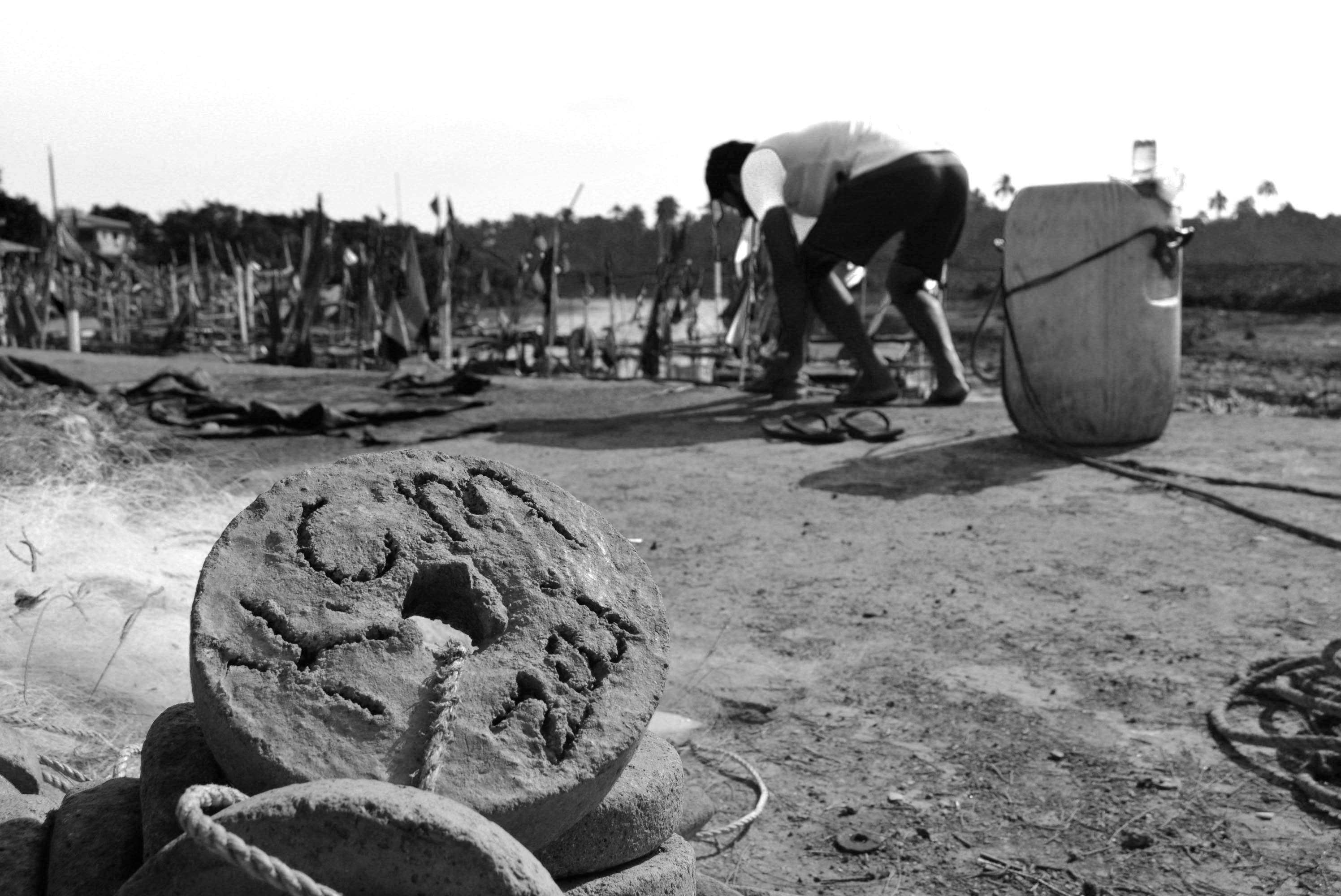
All the fishnets have round weights such as above attached to them for the purpose of stability.
The round weights also serve the dual function of making the fishnets identifiable in case they are lost or cut off at sea. The top arch of the weight is inscribed with the initials of the Tandel the boat (and the net) belongs to. The bottom half has the name of the village on it to avoid any confusion.
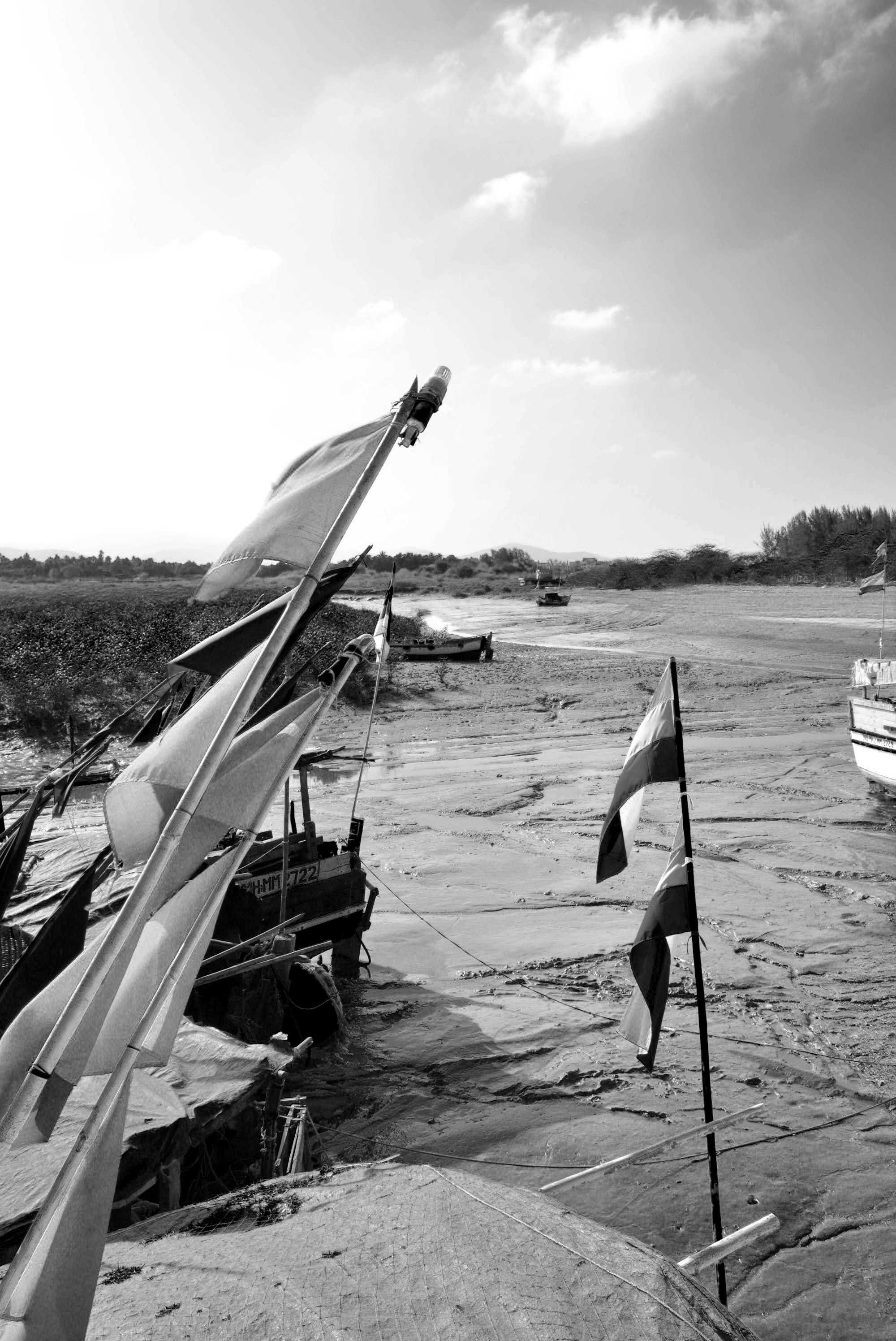
All tandels mark their fishnets with identifiable flags which have solar LEDs attached on top so that they are still functional at night.
Social and Environmental Interaction
The fisherfolk inhabit two scapes — land and sea, and seasonal cycles, their interpretation of the immediate environment and other parallels involved in the business of making a living all form a part of their social interaction with the environment. The community has common beliefs, ceremonies, and restrictions that have been adopted over generations, but which are rapidly evolving as a response to ongoing climate uncertainty.Every year during the month of Shraavan (August) the fisherfolk worship the sea as the giver and protector of the community for five days in the form of a festival called Naral Purnima. The water from the sea is brought home and treated as a guest to pay respect for the sea’s generosity in providing them with life, food and a livelihood. Hareshwar Macchi expressed this sentiment as — “Phukta khaate nahi, aathvan pan thevate (translated from Marathi as: We remember the hands that feed us). Everything is because of the sea. If today the sea decides that it doesn’t want to rain then our world will collapse. We think of the sea when we drink water. We owe our existence to it.” The ceremonial songs for Naral Purnima are in Marathi as the village is in Maharashtra although the majority of the fisherfolk are Gujarati. The community plays songs off YouTube, dance on the beach, and the women always dance more joyously than the men!
A majority of the fishers used the shape which trees form on the horizon as a marker to find their way back home. The fishermen coming back on boats don’t rely on this method anymore because of the increase in smog although the fishers going for low-tide fishing on foot continue to use this method.
The sea is clear and silent at night. You can hear the wind and the boat feels like a swing. There is a saying in the community that the boat keeps them as safe as a mother keeps her child in the womb. If it’s a darker night, the wind gets violent and it gets scary. One of their major fears is getting run over by the bigger ships and it is usually the tandel (captain of the ship) who looks out for them. Fisherman Nikhil Sagar says “Once we get the Paplet (Pomfret), we try to return as soon as possible. Everyone from the village returns simultaneously so even if someone gets into an emergency, we have our people to fall back on. We are mentally very well-prepared to handle any emergencies at the sea. The strong winds are perhaps our arch-enemies. Our only goal is to find the fish and come back because that is the only means of sustenance.”
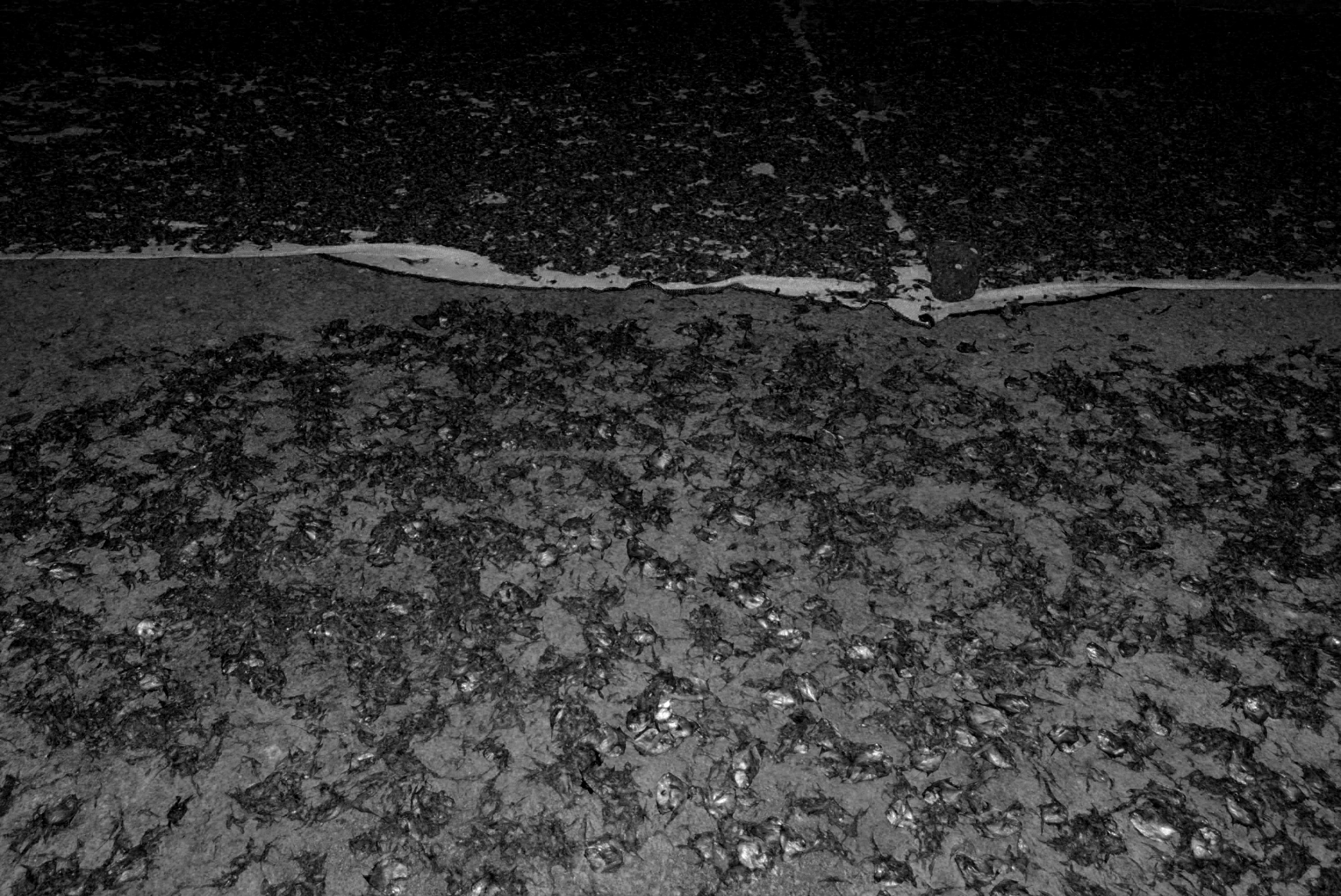
Paplet (Pomfret) and Zhinge (Prawns) kept for 2-3 days under the sun to preserve the catch from going to waste
The fishermen while revisiting their memories of encountering storms at sea said that they did not feel defeated or scared for their lives. “One has to have some faith. We aren’t thieves or robbers; we do the work of God so that’s why we have complete faith on our safe passage. Because who invented storms? Even if one child out of a hundred calls out to the mother, she listens. In the same way, we have trust and patience towards the sea,” said Hareshwar Macchi who has been going into the sea for 27 years now.
Present Day Challenges faced by the Fisherfolk
Ten years ago, lobsters used to sell for INR 1200 and the nets used to cost INR 300. Now they sell for INR 800 when the nets cost them INR 600. Even Paplet (Pomfret) used to sell for INR 500 as compared to its current price of INR 350-300. The fisherfolk say that their earnings are entirely dependent on the rate decided by the market. Suresh Dawane of the Zai Fishing Cooperative Society tells me that the Chinese fish have gradually taken over their export market as are cheaper. For every fish caught by the local fisherfolk here the technologically advanced Chinese fisherfolk catch twenty. According to a report published by the Ministry of Fisheries, Animal Husbandry and Dairying on fisheries statistics in 2019, the quantity of fish exported from the Mumbai port increased from 1965 metric tonne in 2010-11 to 3052 metric tonne in 2017-2018. Irrespective of this, exports in 2017-18 suffered a loss of INR 66.62 crores (660 million) despite having exported 1087 metric tonnes, more. The fisherfolk have concluded that even if they put a hold on fishing for a couple of years, there is no guarantee that they will get an alternative job. “The government should direct more resources and attention towards the fisherfolk. We are also farmers in a way. They think that farmers sow seeds so they have to cope with bad crops but we also invest a lot in diesel and Khalaasis (a term used to refer to laborers on board) which is not accounted for,” emphasized Suresh Dawane.
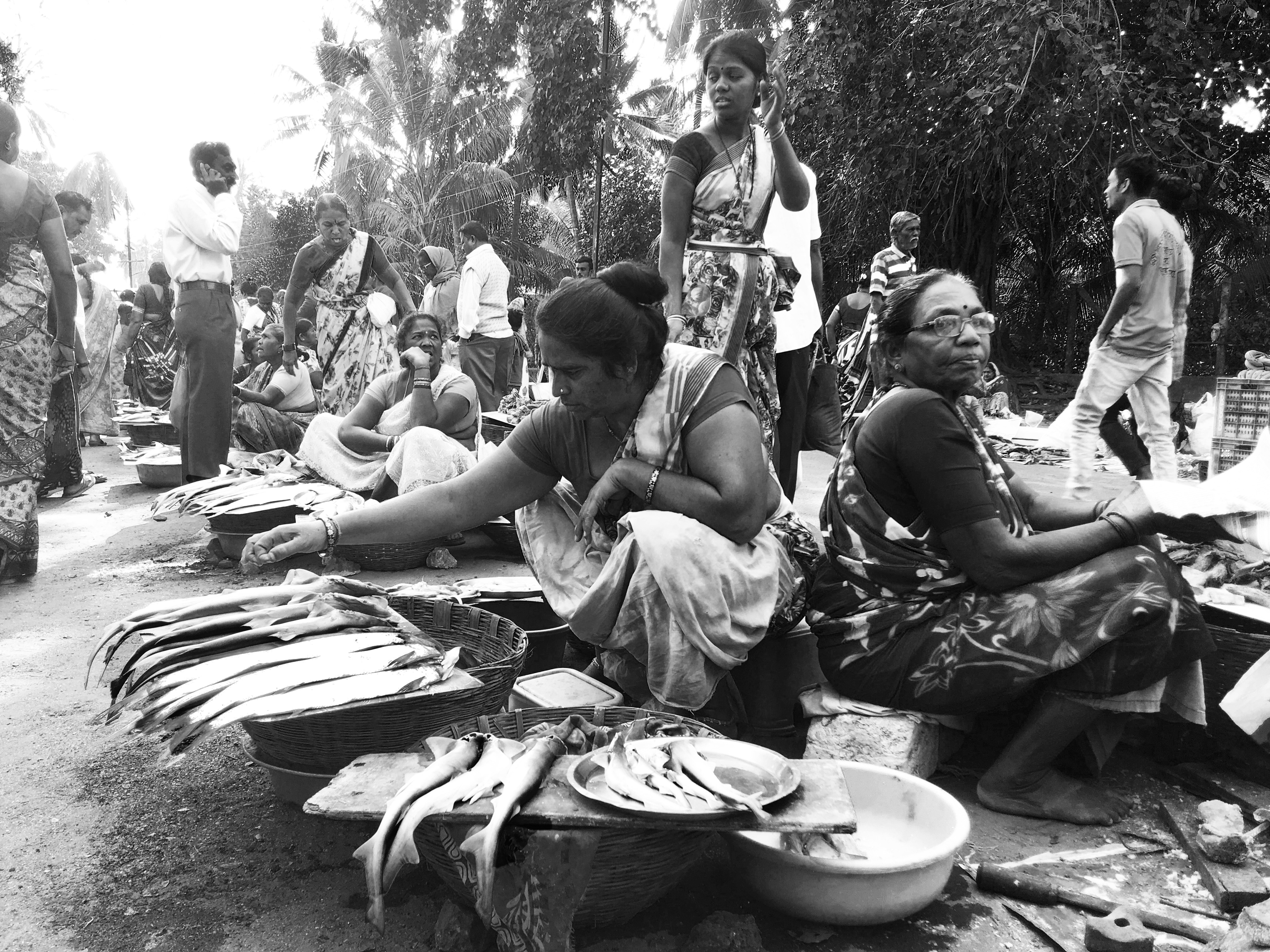
Fisherwomen selling fish at the evening fish market. The market sits daily from 5:30 till sundown in the evening. When the fishers return unsuccessful from the sea fish like Paplet (Pomfret) and Bombil (Bombay Duck ) are not available in the market.
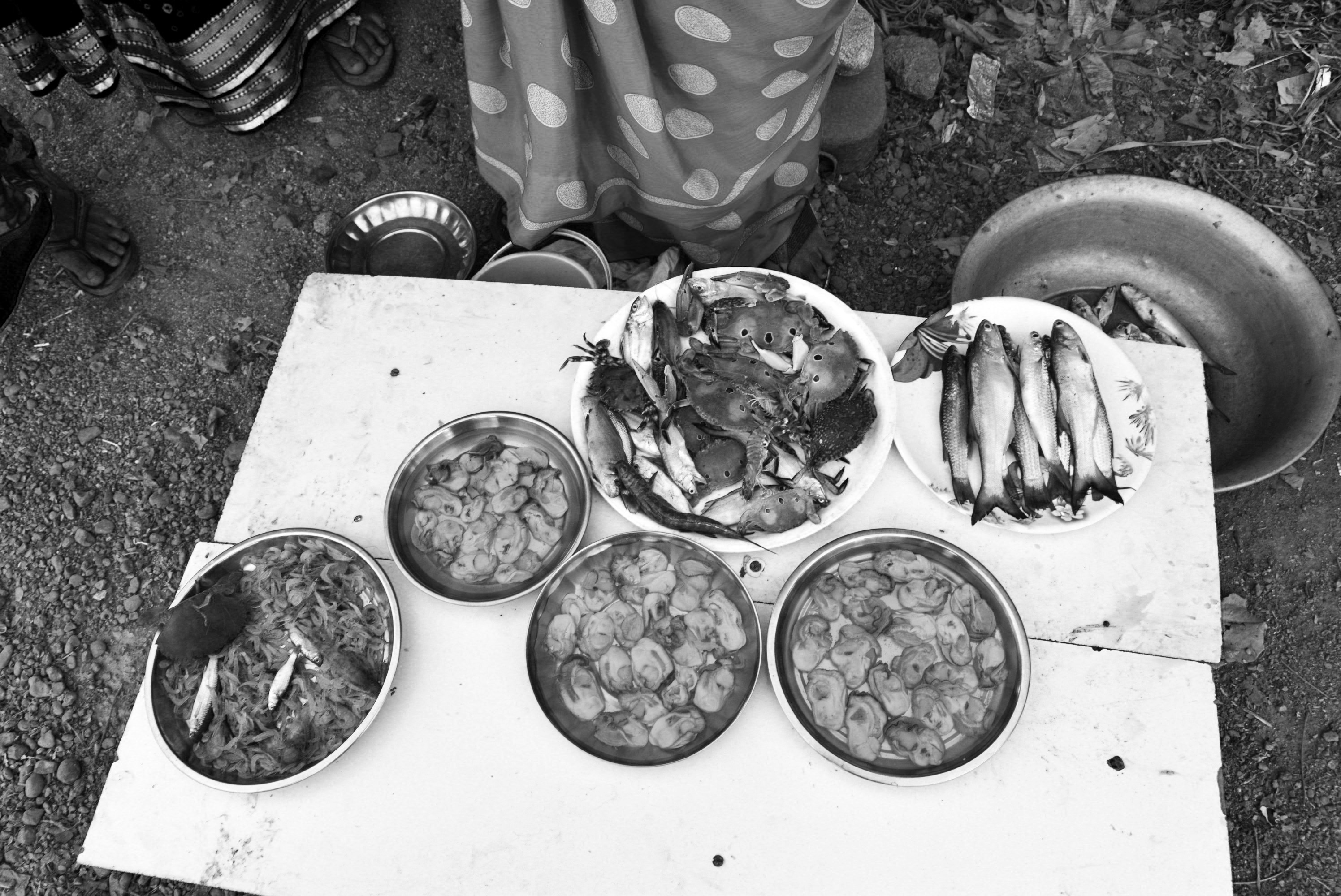
Starting from the top in a clockwise direction: Crabs, Nevati (Mudskipper), Baby Lobsters, Raawas (Fourfinger threadfin), Kalva (Oysters) and Prawns for sale at the local fish market.
The fisherfolk in Zai are stressed as bigger boats capitalise on their catch by overfishing and running over their nets which cause a great deal of monetary loss, time invested and gradually dispirit the fishermen. Saman Machhi points out that according to government rules, the trawlers must keep an eye out and not destroy local nets but that rarely happens. “A lot of our nets get torn. If fifteen nets are destroyed we face a loss of INR 15k and it doesn’t even leave us with fish worth INR 2k,” complains an exasperated Saman.
The fisherfolk hope that the government puts a ban on using cameras to aid fishing. This has caused an increase in overfishing. A single mechanised trawler catches as much fish as a hundred of our boats are able to in a day, they explain. The unsustainable methods used during these fishing activities also kill the juvenile fish which reduces the overall fish stock. In a 2006 article by Telegraph a group of scientists had predicted that the world’s stock of seafood will have collapsed by 2050. The fisherfolk have also noticed a lack of rules and regulations governing the traffic at sea. Some even said that it seems more crowded than the land now.
Earlier the Maharashtra State Government’s advice was to stop fishing for four months during the monsoons as the freshwater flowing downstream acted as a breeding ground for the fish. But now people have started fishing during that period as well. The fisherfolk agree that following sustainable methods and using minimum net sizes, allocating areas to various peoples for carrying out fishing activities and following proper protocols might relieve the problem of overfishing to an extent.
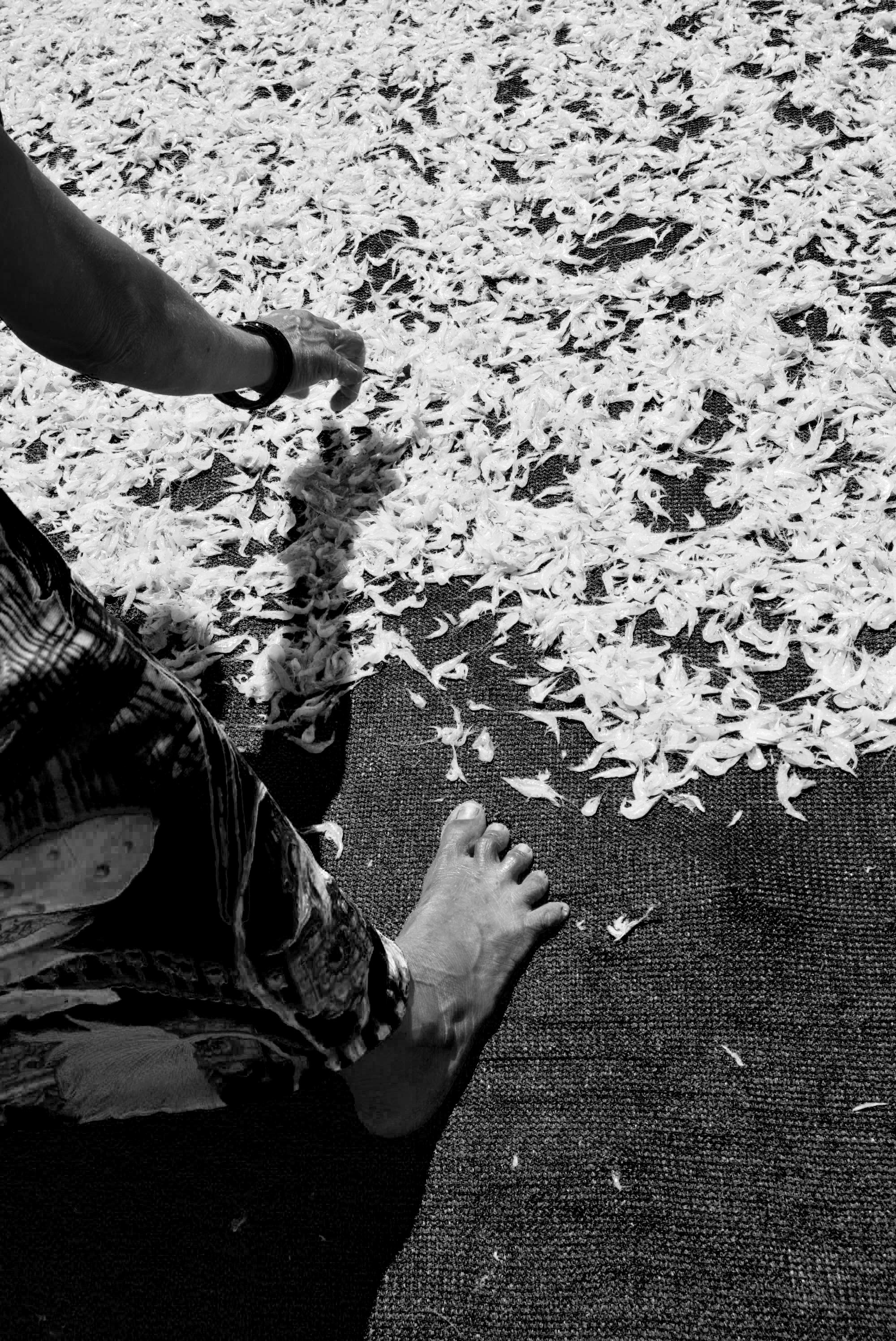
Fisherwoman setting prawns to be sundried.
The monthly expense of a fisher family averages around INR 60,000. The fishermen while practicing local fishing happen to catch fish worth INR 21,000 which leaves them with a monthly loss of approximately INR 35k. If each fisher family suffers a loss of approximately INR 35,000 per month for eight months in a year which amounts to INR 280,000 where does that leave the net loss of the entire village which consists of more than 200 fisher families? How much longer can the community take on losses like these when this has been happening since the past two years? What do they eat, drink and how do they educate their children let alone take care of the basic necessities? “That’s how bad our situation is. It’s very troubling. That’s why our children are quitting their studies. His son (gestures towards his neighbor) just completed a diploma course but cannot afford to study further. He’s very smart but we don’t have the money,” says Suresh Dawane of the Fishing Cooperative Society in Zai.
Hareshwar Ravia Macchi adds “People often question how we fishers live, what we eat and how smelly our clothes are but I don’t think that is the case. We are very scientific in our approach and highly disciplined at sea. We have to maintain certain protocols or we won’t survive for long. If you fall sick you can go to a doctor or rather four doctors can come to you but when you are in the middle of the sea the possibility of that happening is very low.”
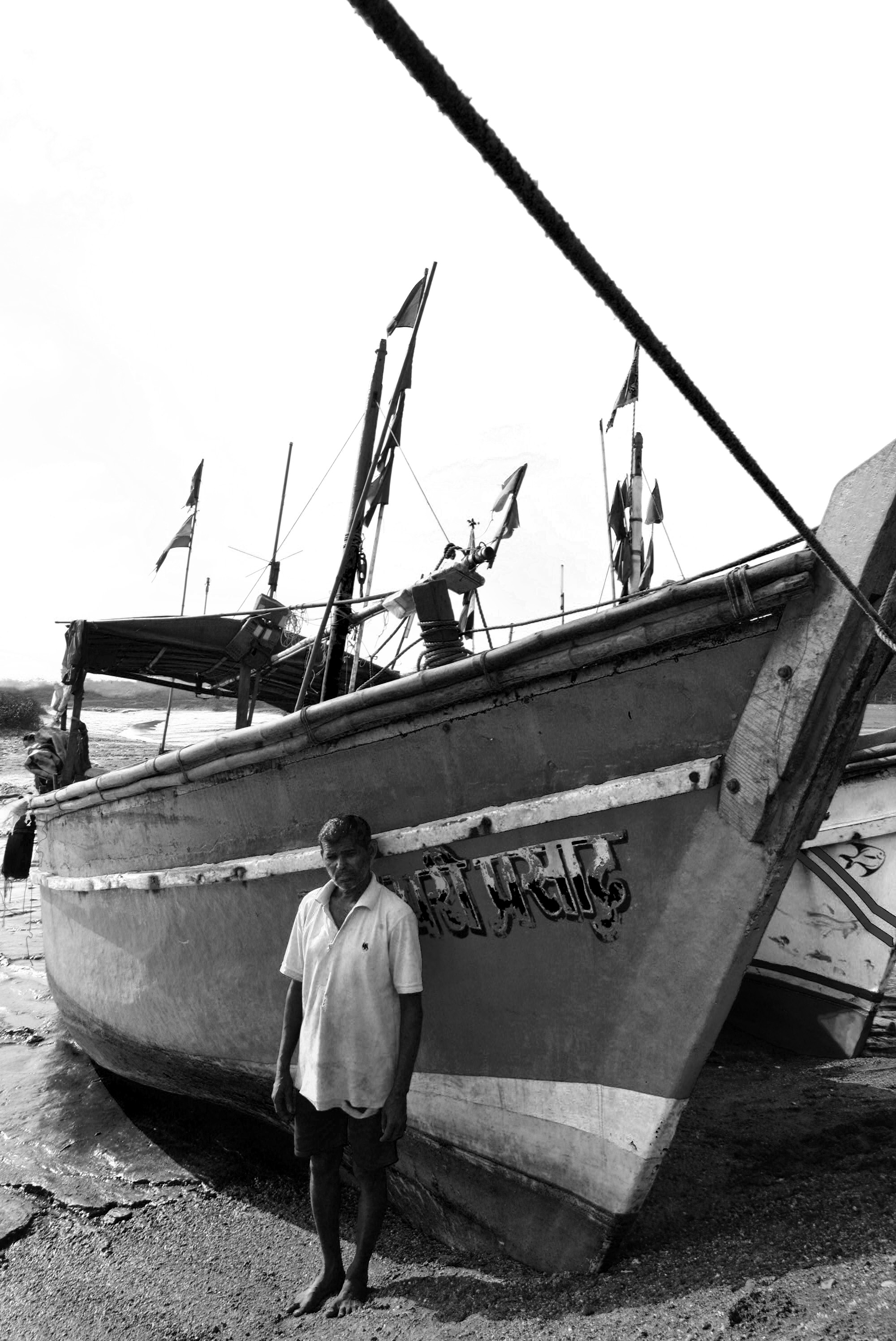
Tandel (captain of the boat) Hareshwar Ravia Macchi posing with his boat 'Jalpari (Mermaid) Prasad'.
There are two local bodies at work to aid the fishing community in Zai. A specific committee is formed to deal with emergency situations and disputes between local fishermen at sea. Suresh Dawane from the local fishing cooperative at Zai informed the author that the informal committee had members from the coastline of Virar in Maharashtra to Daman along the Gujarat coast. The Zai fishing cooperative on the other hand helps the fishers with securing insurance for boats and life. Apart from this they ensure a proper supply of ice, diesel, rope and other commodities required on board. Arrangements for transport, marketing and storage of fish are also made accordingly. The local bodies also play a key role in registering damages caused due to natural phenomenon such as cyclones. They are currently working towards relief aid observing the damage caused due to the Covid-19 global pandemic outbreak from March and Cyclone Nisarg in June of 2020.
About Mrunmayee Das
A film and literature student with interests in lens-based practices, ecology and visual cultures who loves to write, photograph and make films. (2020)